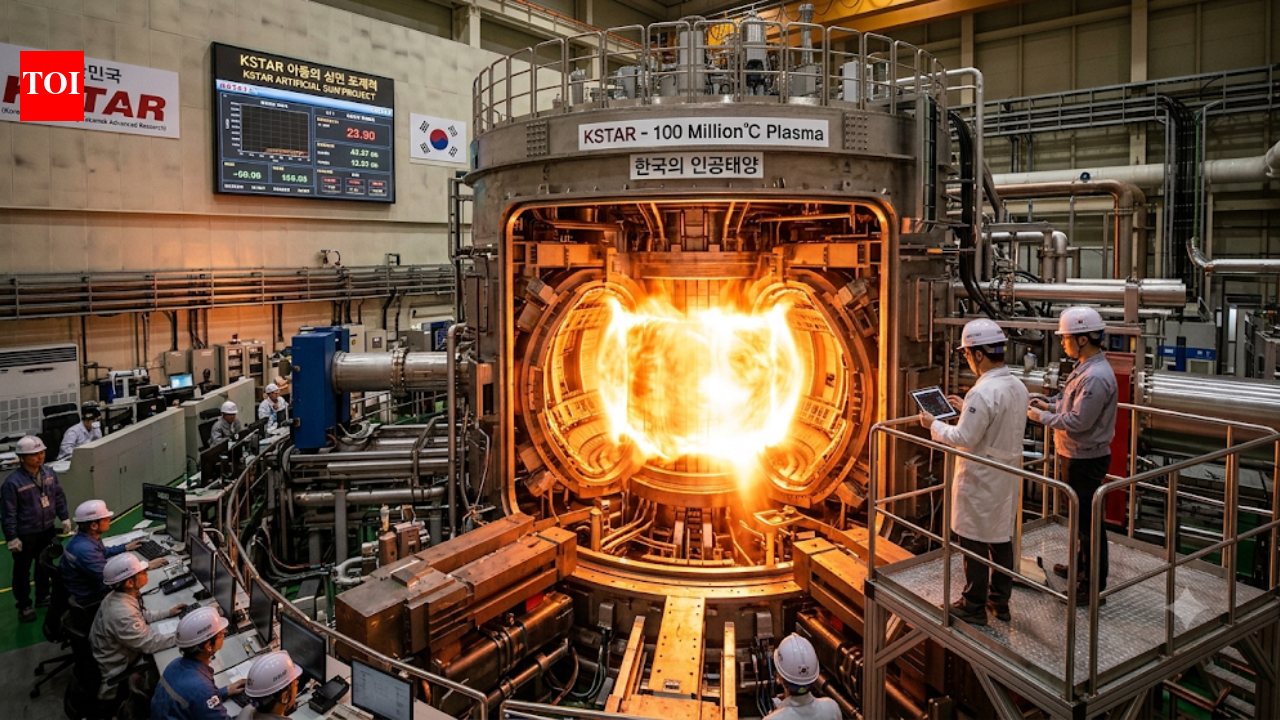
The AI generated image is such an eye sore.
I was going to write something about Gordon Freeman and Resonance cascade failure. And then I saw that it was AI generated, and that explains a lot.
At least they disclosed that it’s ai.
at least we can be pretty sure the text isn’t LLM generated - it’s so clunky and hard to read 😬
Well if it doesn’t light up how can you tell it’s on?
It’s like how everyone thinks that nuclear reactors glow green.
Which is funny, because at times they do glow, but it’s blue (cherenkov radiation)
artificial sun
You can just say fusion reactor
This development by the Korea Institute of Fusion Energy (KFE) is another move towards achieving clean fusion energy, whose ability to generate unlimited amounts of electricity with little to no carbon emission is promising.
The article, like so many others concerning nuclear technology, refused to address the unit cost of energy.
Why is building a large, complex, and temperamental fusion engine more economical than churning out an equivalent number of wind turbines or solar panels? The article doesn’t say
For the same reason someone would have asked “why is building a large, complex and hard to produce solar panel more economical than churning out an equivalent number of coal plants?” decades ago.
It’s improving the tech, which could eventually far and away outpaced every other energy producer. Maybe not now, but in the future. Some are just gung-ho about trying to produce a bunch when they’re not quite ready.
Why would you create another source of heat instead of harnessing incoming one? Also your comparison is a little bit off. This tech will be large, complex, hard to produce compared to solar just because of its nature.
why is building a large, complex and hard to produce solar panel
Solar engines have historically been simple and easy to produce relative to coal and gas engines. We’ve had industrial solar heating technology since the 19th century, even. Sort of the joke of fossil fuel technology, in that it’s been a consequence of heavy R&D investment and industrial build out as much by choice as by any engineering advantage.
It’s improving the tech, which could eventually far and away outpaced every other energy producer.
It’s been a pop science empty promise for decades. We were talking about fusion technology in the 1960s like it was just around the corner. Yes, there’s an enormous amount of output in fusion technology. But it requires even more energy input. What’s more - as the article downplays but is forced to concede - it is highly unstable and difficult to sustain, even at a super-sized laboratory setting.
This is a far cry from fission which can be achieved practically by accident (see the Chicago Pile-1) and is comparatively straightforward to control via mechanical methods.
Even in the event you manage to produce something approaching stable fusion at the size-scale necessary for industrial deployment, there’s still no reason to believe the technology would be cheaper per watt than the indirect capture of an already running supermassive fusion system (ie, the Sun). In that case, it wouldn’t outpace every other energy producer for the same reason conventional nuclear power hasn’t.
There’s a good reason why it’s been talked about since the 60s but never happened:

IIRC that chart only shows US Government investment / spending. A lot of other countries, such as South Korea, are spending on this and even here in the United States large sums are being spent on it by Venture Capitalists.
The “actual funding” line is wildly out of date since there’s several Fusion Companies that have spent more than that each in the past few years.
I mean, that’s certainly some napkin math.
But $3-9B is pretty cheap by modern corporate standards. Does this mean OpenAI will have a working fusion engine some time in the next ten years?
If they devoted billions of dollars per year to it and nothing else, maybe.
Keep in mind that OpenAI still hasn’t made any profit, their entire valuation is based on hype that will be exploited to steal money via the ipo, and then the Altar will beg Trump for a bailout to prevent a bankruptcy.
Altman and Musk both tried to get their companies into Nasdaq and the S&P 500
They really pushed, because retirement funds are required to buy shares of the the entire index, and if any of the companies in that fund have sudden bankruptcy issues, the government is more likely to step in to save the company. Theoretically, this saves the retirement funds. It never has, but that’s how saving the company is sold.
Anyway the Indexes refused to change their rules so the bailout will have to come from bribing Trump.
Nasdaq100 is already greenlit.
I had thought that, but then I couldn’t find the source, so erred on the side of caution.
If they spent real money (not paper passing around deals between companies) over a decade and had tens of thousands of scientists and engineers and institutional knowledge and partnerships with academia in order to do it properly, yes they could.
But we both know they don’t have any of those things, so no practically they couldn’t.
I saw a talk from someone working in the field a few years back. The “fusion is only 10 years away” had a small proviso “if fully funded”. The actual funding was barely enough to keep the lights on.
That has now changed. It’s gotten close enough that private investment has decided it’s worth investing in. I believe the only really big problem left is the wall material. The neutron flux transmutes the elements making it up. This makes it difficult to maintain a hard vacuum, since the wall can start leaking and/or outgassing, forcing a shutdown to replace them. On a minor plus side, if you dope the walls with mercury, it transmutes to gold, in commercially viable amounts!
Fusion has several advantages over fission. The biggest is the impossibility of a meltdown. The very difficulty in balancing the reactor means that it shuts down fast and mostly clean. This would let them be placed far closer to population centers. They could provide a base load supply, in the way nuclear could/should have.
On a minor plus side, if you dope the walls with mercury, it transmutes to gold, in commercially viable amounts!
There’s literally a startup promising to exploit this. Although, how they’re going to get a commercially visible fusion reactor started remains to be seen
Meanwhile solar and wind have been funded generously for decades but still can’t get us free of fossile fuels.
You can just say fusion reactor
The Times of India is a rag that literally accepts bribes for positive coverage; sensationalist garbage is their bread and butter.
But it gets worse: this story is over two years out-of-date.
The KSTAR Research Center at the Korea Institute of Fusion Energy (KFE) announced on the 20th that during the ‘2023 KSTAR Plasma Campaign’ conducted from December of last year to February of this year [2024], it achieved a 48-second operation of ultra-high-temperature plasma at an ion temperature of 100 million degrees and a record 102-second operation in high-confinement mode (H-mode).
This happened back in 2024. Here’s a paper.
I remember reading about russian intelligence sponsored anti vaccine propaganda from the time of india, targeting poor countries like pakistan and in africa and the like.
Technological progress.
Need sun for solar, so won’t work well for space when you get further out, and no wind in space.
But there is an air and space museum.
no wind in space
Can it be used to power a turbine? Or just propulsion like a sail, because what if we want to go towards the sun…?
It also has diminishing returns in relation to distance to the sun.
In space…? Because that requires moving one part while the others stationary…. The friction from generating power would spin the rest of the satellite, or would need to expend power to resist it.
Windmills have used sails as fins for long time lol, its nothing new, im trying to get you think critically here.
In space…? Because that requires moving one part while the others stationary….
Or moving one part opposite the direction of another, to create resistance.
Windmills have used sails as fins for long time lol, its nothing new, im trying to get you think critically here.
There’s plenty of conversation to be had about efficiency, heat venting, gross productivity. But “you can’t capture energy from another moving body” is something billards disproved several centuries ago.
Just because you can capture it doesn’t mean it’s useful or beneficial.
Not much science could be done with a constantly spinning satellite. And spinning stuff in space does some weird shit, we already know this.
A single solar panel is basically useless. You need a huge field of them per small city, and by the time you do have your huge fields of wind and solar, you then need giant grid batteries, and you still often fall short, which means that to be safe you need to double or triple your solar and wind build out.
Which is why most solar and wind projects are backed up with methane burning generators.
Nuclear on the other hand, takes up a tiny fraction of the space and outputs orders of magnitude more power, safer and cleaner than any other form of energy.
South Korea doesn’t have a lot of land mass for solar, they do however have competent engineers and scientists.
Fun fact, most of the fearmongering around nuclear has been paid for by oil companies, starting with Hermann J. Muller working for the Rockefeller Foundation, to Robert O. Anderson, CEO of ARCO giving $200K to a man to start an anti-nuclear environmentalist organization called Friends of the Earth. The Rockefeller Foundation directly funded Greenpeace up until just a few years ago.
As for Fusion, yeah, we can sustain a reaction by feeding energy in, and sometimes, we can observe more energy out than in, but we have absolutely zero ways to capture that energy.
Water+heat = steam = power
Solar actually overtook nuclear as least-killy-per-gigawatt about a year (maybe even two, now) ago, although obviously killing people isn’t the only bad thing a system of power generation can do.
It’s not hard to overtake nuclear when we’re shutting nuclear down. Thankfully that trend is reversing, because if we had a full nuclear build out, we wouldn’t really need anything else.
Especially SMRs, those are quite amazing, well, amazing for something that just heats water to make steam to drive a turbine.
It doesn’t.
Fusion isn’t as bad as fission or fossil fuel. If they can get it to work. The reactor needs to run continuously (for days) and the energy output needs to be positive. Then it would have a huge impact.
Every energy source as its drawbacks. I.e. Solar panels and wind have the recycling of compound materials issue - it’s all glued together. And the environmental impact of source materials production, i.e. neodymium. Mining, refining,…
Some are worse than others. But none is or will be impact free in terms of sustainability or environmental destruction.
Fusion isn’t as bad as fission or fossil fuel.
To date, terrestrial fusion has been a net-negative energy system. That’s strictly worse than fission or fossil.
Every energy source as its drawbacks. I.e. Solar panels and wind have the recycling of compound materials issue - it’s all glued together. And the environmental impact of source materials production, i.e. neodymium. Mining, refining,…
Do you think we’re getting terrestrial fusion without mining or materials compositing? What do you think fusion reactors and their attendant facilities are made out of?
We’re getting into reactionary FUD about wind turbines when we start waxing poetic about the environmental impact of big fan blades and dynamos (which are just as critical for coal and gas plants, btw). At some point, you’re still just converting mechanical energy to electrical energy, no matter what system you’re proposing. All of that will require industrial metals and conductors.
Is this a bot? These can’t be real responses…
People want to vote for trump a 3rd time. It’s definitely possible those are real responses.
Fusion isn’t as bad as fission or fossil fuel. To date, terrestrial fusion has been a net-negative energy system. That’s strictly worse than fission or fossil.
My mistake. I did not specify in what regard. I had the waste in mind. Fusion waste is radioactive for a few decades. Fuel wise, there is an abundance of Deuterium, like a gram of it in every bucket of ocean water give or take. Tritium? That’s the harder part.
You are right. It doesn’t work yet. And it will be too late to solve the current energy crisis. If they get it working at all. But I see no harm in trying.
Your remaining statements: I did not intend to say that solar and wind power are bad, but they are not flawless (again: sustainability and sourcing).
Fusion reactors are in prototype experimental stage, of course they use more energy than the output for 102 seconds. Obviously, that’s not the goal.
Write a letter to ITER and tell all those PhDs they are stupid.
Write a letter to ITER and tell all those PhDs they are stupid.
Nobody at ITER is promising to commercialize this technology at scale any time soon.
(Not my field. The following is armchair speculation.)
Why is [fusion] more economical than [solar/wind]
TLDR — It’s not. For distributed/residential, bulk power generation, and light-duty transportation, solar has already won so decisively that fusion is not likely to catch up this century. But those aren’t usually the target applications.
TMK, Fusion offers most of the known advantages of fission (smaller footprint, superior energy density + capacity, output that’s weather-independent and geography-agnostic, etc.) but with significantly better safety and waste profiles.
Its versatility as a thermal source enables many industrial applications requiring temperatures difficult or impossible to achieve via electrification alone.
The reaction itself is directly applicable to neutron production.
There’s some even more far flung applications like outer planetary and deepspace space travel.
And others. All to say, it’s for niche and future applications PV can’t touch.
Its versatility as a thermal source enables many industrial applications requiring temperatures difficult or impossible to achieve via electrification alone.
That’s fair. I guess if you really need a spicy blowtorch…
The obvious advantages would be less land use, great for smaller nations, and on demand power without the need to build back-up batteries.
Plus those are the immediate benefits who knows what we could do with that level of power generation. Maybe we could even make better space craft if the technology advances enough
You still need to boil water and turn a turbine with fusion, don’t you? Not something that works well in a space craft. Could the plasma be used in propulsion directly somehow?
I’m just imagining a steampunk spacecraft running on fusion now tbh
That would be wild. Something for a vidya game for someone with more artistic talent and free time than me
Because there’s currently only one place that should theoretically be able to create one that works at scale to become energy positive, thanks to a novel way of making the electromagnets used to contain the plasma under enough pressure. As per usual, a beneficial reactor tech is still “five years out”. We do keep inching closer though.
Artificial sun sounds fun tho. Let us have our God damn fucking whimsy. The world is bleak enough.
I’ve just been reading this article over and over again since the 1980s. We’re way past whimsy and on to scammy pseudo science
Yeah, fusion reactors are nothing new, as for why it’s because they are not self sustaining and release less radiation, the problem with renewable energy is the availability and instability, that’s why most countries don’t allow more than a certain percentage of renewable energy into the grid.
Wind and solar can’t get us free of CO2 yet.
This is the problem, this idea of 100% carbon free or “whelp, might as well give up and burn coal”.
We will always need buffers to grids of solar and wind power, they point is we are reducing outputs significantly, aiming for a range the planet can deal with.
Funny for an ecologist to admit that you don’t care about climate change if nuclear power is can be ended.
For your interest, it’s at least 20 years that renewables do absolutely nothing for CO2 emissions. Meanwhile nuclear power is carbon free since the 70’s.
This news is two years old and is from the garbage pile that is timesofindia. It doesn’t deserve to be posted in a tech community.
Wow it’s pretty cool that it can maintain magnetic confinement with that giant window cut out of the containment vessel.
I’m not sure that lab coats and hard hats will protect against the x-ray black-body radiation though.
Isn’t the Times of India not reputable? I seem to recall some shady shit from them, including I think Russian sponsored anti vaccine propaganda aimed at poor countries.
Meanwhile, the US sits in the corner playing with their feces
Can’t we get just one article that doesn’t have comments about the U.S.? The article has nothing to do with the country.
To be self-denominated as the “greatest country in the world” yeah, it Jas everything to do with the US of A.
By that logic the UK has a few hundred more years worth of getting shit talked to go. Not to mention France, Germany, Russia, China, etc.
Damn well near every country has claimed to be the greatest in the world at various points.
Hell North Korea says it more then the us does!
If your goanna clown on the us at least do it for something real and not for the equivalent of propaganda shit posting.
I’ll try harder next time.
I’ll try harder next time.
Really? I think we’re reading different articles then bcz my understanding was that this article is about a Korean institution and their research into Fusion Energy.
And how the US is just guzzling oil and doing nothing about curving that, yeah, that’s what it is.
Can you just go away? This is a boring conversation now.
I can. Now, will I? That’s an entirely different question. Do you want me to go away? Because if you do, there’s a chance I could consider doing something ro make you happy, like going away. No guarantee though.
if you can be anything… be the best.

How many Courics is that? Damn
National Ignition Facility?
For weapons research. Has nothing to do with generating commercial electrical power, indeed, it never will. Exactly like all the other fusion devices.
https://usfusionenergy.org/fusion-united-states maybe just admit you’re wrong.
The NIF’s work is genuinely impressive. Achieving ignition ten times with a record yield of 8.6 MJ in April 2025 is real scientific progress and is amazing. American scientists are not the problem, nor did I say that they were.
But notice what you just linked me. NIF is a Department of Energy federal research facility. Publicly funded. Government science. The same category of institution the current administration is actively dismantling.
While there were past achievements, at the same time the Trump administration proposed 40% cuts to NIH and 55% cuts to NSF in 2026. By November 2025, $2.3 billion in NIH grants and $700 million in NSF grants had been frozen or terminated across nearly 4,000 projects. NSF awards dropped 50% in 2025 compared to recent years. Over 25,000 science agency employees left, many voluntarily through resignation incentive programs, many at early career stages. The NSF Graduate Research Fellowship halved the number of fellowships awarded in 2025. Universities across the country froze hiring and cut research spending in response.
The fusion breakthroughs you’re pointing to were built on decades of sustained public investment and institutional infrastructure that is currently being systematically defunded. The scientists who achieved those results are the same ones that are now being told their grants are frozen, their fellowships are cut, and their agencies are being restructured around defense priorities.
So yes, the US has done remarkable fusion research. Past tense is doing a lot of work in that sentence. The comment was about where we’re headed, being present tense. And where we’re headed is a country that just told its early career researchers their scientific purpose has been knocked off course by illegal funding cuts while other countries continue to make advance after advance with no signs of stopping, even further, being fueled by the exodus of researchers.
So, yes, the US is sitting in the corner having, at present, taken a very anti-science and anti-education stance through funding cuts and deregulation.
Reading comprehension gets them every time 🤔
Budget cuts:
https://cen.acs.org/policy/nih-nsf-ostp-science-research-funding-cuts/103/web/2025/12
https://www.sciencenews.org/article/nih-nsf-cuts-2025-data
https://www.aau.edu/key-issues/federal-research-cuts-threaten-us-innovation-and-leadership
https://www.nature.com/immersive/d41586-026-00088-9/index.html
Proposed cuts:
https://cen.acs.org/policy/trump-budget-fy2027-science-nsf-epa-nih-fda/104/web/2026/04
Researcher exodus/brain drain:
https://medium.com/scitech-forefront/science-funding-cuts-break-the-research-pipeline-ce02c7073253
This is not how it looks. It’s also not a artifical sun.
It’s slop.
Currently we still don’t know whether it’s possible to generate more power than you need to maintain the fusion.
ITER is the European project that should test that. It still is an experimental reactor and won’t generate power.
Several other reactors are currently being built, but only recently they started building ones that in theory could run for a longer time than a few minutes.
But nobody knows if it will be useful.
Well they have two commercial plants coming online and expecting to produce power sometime in 2030. So they better figure it out!
There’s one company that claims they’ve done it at lab scale and are building it out at a power plant scale now.
The power of the sun, in the palm of my hand.
I’ve seen this headline in different ways for the last 20 years.
deleted by creator
Huh? No…you haven’t? Do you mean in comic books?
This is nuclear fusion.
Tanning beds will never be the same…
Something will have to power the billionaires’ sealed private luxury ecosystems.
CIA wondering how theyre going to murder South Koreas scientists next.
“100 million degrees centigrade” sounds like they are trying to over compensate for the lack of a great leader like Kim Jong Un
Right?!? Silly, functioning democracy could have had a kingdom.
So… Probably just 10 or 15 years right…? Right … ?