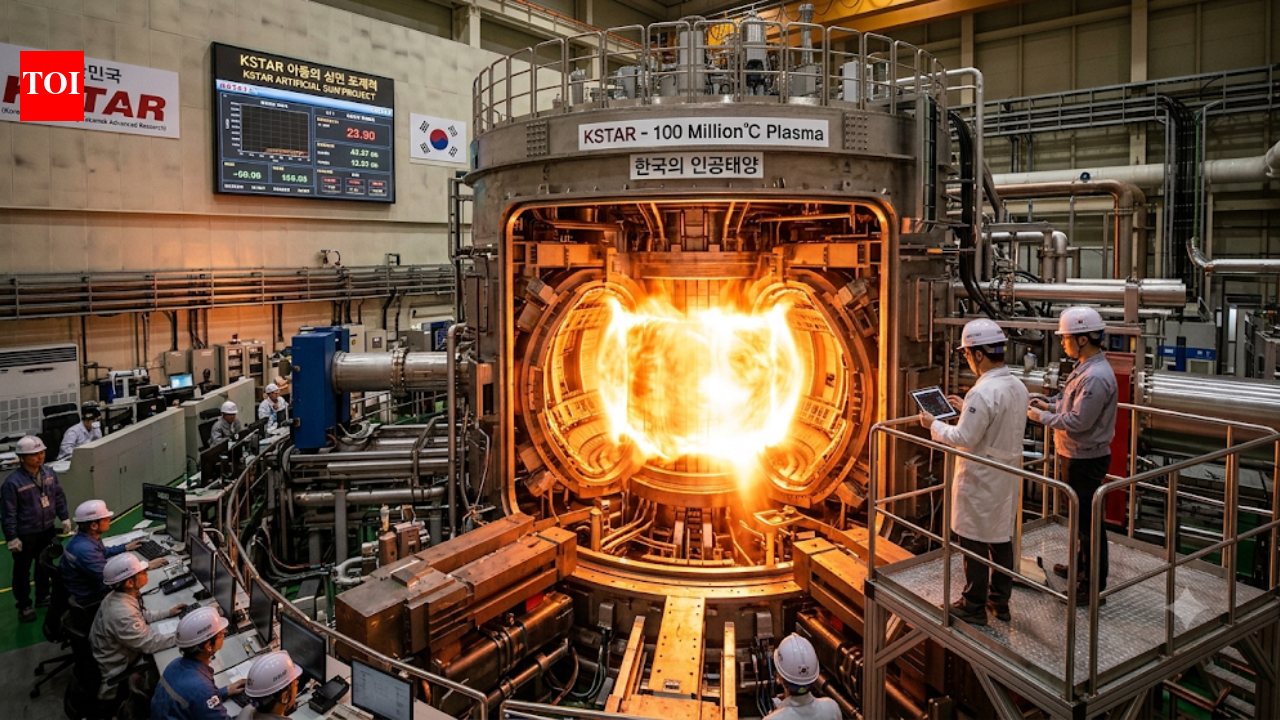
The South Korean artificial sun, which goes by the name KSTAR (Korea Superconducting Tokamak Advanced Research), has made an important scientific discovery concerning nuclear fusion by being able to sustain plasma in high-confinement mode for a period of 102 seconds while simultaneously managing to keep plasma temperature at 100 million degrees centigrade for 48 seconds. This development by the Korea Institute of Fusion Energy (KFE) is another move towards achieving clean fusion energy, whose ability to generate unlimited amounts of electricity with little to no carbon emission is promising.


(Not my field. The following is armchair speculation.)
TLDR — It’s not. For distributed/residential, bulk power generation, and light-duty transportation, solar has already won so decisively that fusion is not likely to catch up this century. But those aren’t usually the target applications.
TMK, Fusion offers most of the known advantages of fission (smaller footprint, superior energy density + capacity, output that’s weather-independent and geography-agnostic, etc.) but with significantly better safety and waste profiles.
Its versatility as a thermal source enables many industrial applications requiring temperatures difficult or impossible to achieve via electrification alone.
The reaction itself is directly applicable to neutron production.
There’s some even more far flung applications like outer planetary and deepspace space travel.
And others. All to say, it’s for niche and future applications PV can’t touch.
That’s fair. I guess if you really need a spicy blowtorch…