Is there no simple anymore? Plane A went this far on 5 dollars electricity. Plane B went the same distance on X dollars worth of jet fuel. I want to know the distance travelled and I want to know what “X” is.
$5 for 30 minutes in the air. pick any speed you want. it doesn’t matter. avgas and jet fuel don’t compete with $5.
I pick 30 minutes at Mach 7, here’s your $5 Canadian and please get out of my way, I do intend to board now.
i definitely won’t be in your way. bring back pictures.
Well, the data we do have is that the flight was just under 30 minutes and very likely under 100 miles.
From the Wikipedia on airline fuel efficiency:
The worst-performing flights are short trips of from 500 to 1500 kilometers because the fuel used for takeoff is relatively large compared to the amount expended in the cruise segment, and because less fuel-efficient regional jets are typically used on shorter flights.
In the example values table, the most efficient plane for a 560km trip burns 0.92 kg of fuel per km, so doing some rough math and assuming the electric plane travelled 100 miles, that would be roughly 148kg of fuel, or 50 gallons (190L).
At current jet fuel prices ( $3.76/gallon ) that’s about $188 US in jet fuel as a rough estimate. It’s unclear if the test flight went up to full altitude or if the plane was at full weight, so a fair comparison might have used even half as much jet fuel.
Edit: From some of the other comments, it seems like they might have only considered flight time as cruising time, not takeoff and landing, so my numbers will be quite far off if that’s the case. My gut feeling is that this is probably the case, because this seems like too big a difference otherwise.
I did my best to find any technical data about the flight. Couldn’t find any actual numbers. FWIW it’s not intended to be a standalone method of powering the aircraft for commercial use; they plan on making it a hybrid, which makes far more sense as far as range and payload are concerned. Best guess a 25000 lb aircraft like this will probably cruise around 120-150Kt at a nice, slow, efficient airspeed for a test like this. So maybe a 40-50 mile flight because “air time” probably started as soon as they lifted off.
Yeah the problem is they also don’t tell us the load during the flight. From the lift equation (let’s be hand wavey) if they’re a similar size to a regional jet (same planform area) your heavy lift is better driven by speed than lifting coefficient. Of course, it’s hard to go fast with electric props, so I wonder if a safe ceiling is probably
400Kt300Kt?Gives a nice range of you know… 40 to
200150 miles.Edit:
No way. The speed record for a prop aircraft currently stands at about 300Kt. If we use that generously our new ceiling is lower.
It’s right there, friend.
25,000lb. Reading the article it says “more than 25,000 lb”.
We should assume they used a highly efficient airfoil that can maintain the most efficient possible cruise for the demonstration aircraft probably at L/D max if they’e looking for time aloft, so I doubt it’s even worth considering top speed or ceiling. It would be interesting to know what NACA profile they used and what the top speed characteristics would be.
Edit: looks like a Vne of 140 Kias. This is not a fast aircraft. Also a minimal useful load. If you make a couple clicks through to the site of the test it’ll give you more info.
This article is idiotic.
$5 cost. 25,000 pounds. BUT OVER WHAT FUCKING DISTANCE?
$5 gets me 23 miles in my Delica. It gets me 100 miles on my motorcycle. It gets me 30 miles in my Porsche 914. But the article says nothing about distance.
Heart aerospace’s website indicates the X1 demonstrator has a 140kt “VNE” - never exceed - speed. So it’s probably safe to assume cruise speed would be closer to 100kt, and $5 of electricity used in half an hour might equate to around 50nm straight line distance.
It’s pretty impressive for a plane roughly equivalent in size to a 30-seat turboprop airliner like the EMB 120
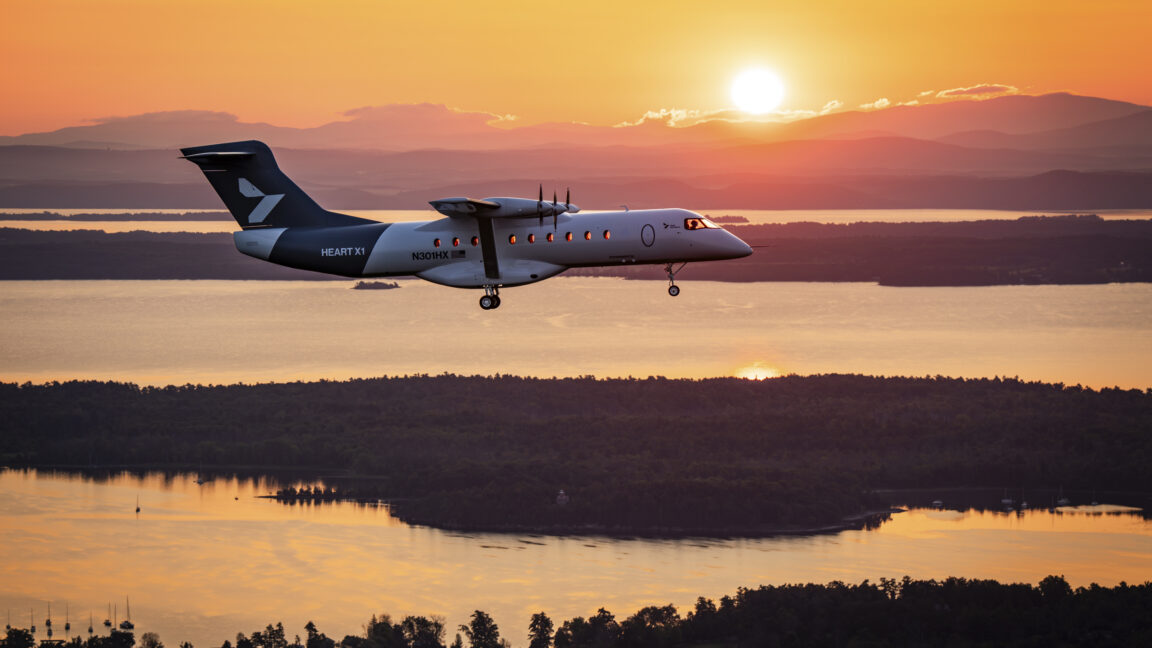
The first flight of the largest battery-electric aircraft to take to the skies lasted nearly half an hour while costing just $5 of electricity. That aviation feat comes at a time when jet fuel prices have skyrocketed because of the US war with Iran.
At what airspeed?
Fast enough to take off and then not fall out of the sky.
It could grip it by the husk.
It’s not a question of where he grips it! It’s a simple question of weight ratios. A five ounce bird could not carry a 1 pound coconut!
Did you reply to the wrong comment because you’re quoting time, not distance?
Literally the first sentence:
The first flight of the largest battery-electric aircraft to take to the skies lasted nearly half an hour while costing just $5 of electricity.
Can your Porsche 914 fly for half an hour on $5 of fuel ?
My 1975 was tuned for distance. When I drove it from Key Largo to Seattle, it did 35mpg average over the 3500 miles I drove. That car was lost in an accident, sadly.
25 miles per gallon. 30 minutes would be 12.5 miles on half a gallon.
My current one does about 25-30 mpg. It weighs 1950 pounds. So, yes. It can comfortably do half an hour on one gallon or so and have fuel left to get me to a refill.
They have flat 4 two liter VW engines. Extremely efficient if tuned correctly. One top of that, there is a direct 1 to 1 drop-in electric kit for these. When my current engine dies, I have an electric kit I’ll put into it to make it an 914E.
deleted by creator
Off a cliff yeah
It would have to be a very high cliff.
Anyone know the terminal velocity of a falling Porsche 914? lol
Point to me in your quote where it talks about distance.
I’m guessing it mostly flew in circles, since it’s a test flight that happened “at Plattsburgh International Airport” instead of between two locations. 27 minute flight, whatever that’s worth.
$10 an hour still seems really good though right? I’m not sure how much Airlines pay currently for fuel though.
Only article I could find was this: https://flyinginsight.com/2026/02/14/how-much-does-it-cost-to-fuel-an-airplane/
On average, a 737 or A320 consumes between 2,500 and 3,000 litres of fuel per hour
Take a typical two-hour flight, such as Amsterdam to Barcelona. The total fuel burn would be approximately 5,500 litres. At a reference price of $0.59 per litre, that translates to around $3,200 in fuel costs.
So that’s $10 an hour down from $1600 an hour? Seems decent.
The X1 demonstrator is more comparable in weight and power to an EMB 120 Brasilia, a 30-seat turboprop. Forum chatter seems to indicate those burn around 1000 lbs per hour, or $335/hr in fuel using the $0.59/liter price you mentioned.
Dropping down to $10 is still pretty decent lolYeah except this is a tiny little plane and a 737 is huge. So those comparisons don’t make much sense.
23 miles lol. For $5 I get about 125miles in my Atto3
With horse power and cargo capacity an airplane has I really doubt it
That seems like really bad efficiency, or really expensive power. I used to have a Nissan Leaf that would do over 5 miles to the kW. Even with rather substantial battery degradation, I could get 80 miles to a charge, and a full charge would run me about $1.25 at the local utility rates.
Charging at home vs public charger, driving speeds, hilly terrain, etc.
i just got back from a week in bali. we rent a mini ev 2 person car to get around and in the span for the whole trip we literally spend $0 because we charge them off the wall plug of the villa we stay at
but if we want to be pedantic the car is Wuling airev and iirc it has 17 kwh of battery. that is quite enough for us for the whole week, we only need to charge it once at 60%. so lets say its around 7 kwh. in Indonesia a kwh cost around $0.1. so for a whole week it only need less than a dollar for ‘gas’
I can understand a hybrid train because of certain sections of track electrification issues and the fact that diesel electric is how even trains that run entirely on diesel operate so you’re essentially just toting around a generator to operate your already electric engine. I understand hybrid cars with regenerative braking and range extension. I don’t really understand hybrid planes.
Like I can imagine electric is more efficient for takeoff because electric engines produce more initial power generally than what fossil can match per engine size(a big part of both hybrid trains and cars both using batteries for initial acceleration) and then you cruise with jet fuel. I’m just having a hard time imagining it is worth it from a defossil fuel perspective or from a straight efficiency perspective.
What if the worthwhile goal and priority were in fact to “defossil”?
Combustion engines have maximum fuel efficiency at a specific RPM. A Hybrid has the advantage that you can run that engine at maximum efficiency 100% of the time and using the generated electrical energy to generate motion. The gains by being able to keep the ICE at peak efficiency are more than the loss you take from the conversion. That’s the same principle as in hybrid cars - look up Technology Connections video where he analyzes the behavior of his hybrid car. It is for sure preferable to than just the ICE directly, losing a lot of efficiency and therefor fuel because of differences in needed power output. Combining this into a plugin-hybrid makes - as you said - the takeoff use no or just the default amount of jet fuel at all.
This will not eliminate the need for jet fuel, but even a reduction is preferable to the status quo. Until we get batteries that are light enough while keeping energy density at least as high as now (preferably higher), purely electric long-range flight is not an option that’s available.
It’s even better, it’s not the same cycle as a regular gas engine, it’s something more efficient.
I don’t think you’ll ever get there for flight personally. Just need to accept synthetic aviation fuel as the only real option for energy density (both volume and weight) and accept certain modalities being absolutely priced out of air transport.
I guess my main issue is you’re now flying around with those takeoff batteries and extra engine components. Is that really ever going to be worth it for anything but those short hop flights this is designed for? And if not why are we even investing in this because those short hop flights frankly need to be eliminated for trains anyway.
But why you dont believe it? OP gave a detailed rebukal of your initial post, and then your answer is “I just don’t believe, just accept that …”
You want to know why I don’t believe we’ll get batteries with enough energy density for sustained long haul flight? I was responding to their last sentence. Ya know, acknowledging that batteries more dense than hydrocarbons isn’t really on the radar so for that aspect of things synthetic aviation fuel is pretty much what you gotta accept to go for zero carbon. I had already agreed with them that it’s more efficient in takeoff in my initial post. They just expanded on why. I frankly am perplexed at what you think I’m dismissing since we largely agree.
To be fair, you probably don’t need to achieve the same energy density as hydrocarbons for the vast majority of flights. Yeah, non stop flights from canberra to stockholm or similar distances will probably (at least in our lifetime) always depend on high density fuel. But I can definitely see a near future where 100% of flights on the same continent can be run 100% electric. The energy conversion to electricity is most efficient in power plants and solar, so making sure that as many flights as possible are powered by those sources is for sure something that is preferable to anything we are doing today.
Also, those batteries - after having outlived their usefulness for aviation because of capacity loss - have still a long live in front of them as energy storage for the energy net itself, where a loss of 20% capacity isn’t a dealbreaker. Since the largest issue nowadays isn’t generation of power, but storage of the same for covering nights, building high capacity batteries is a good thing regardless of initial usage.
Edit: WHY the fuck aren’t airports already plastered full of solar cells?
I haven’t really seen proposals for planes that are full electric beyond just toys for rich people to do short hops but you might be right that battery planes might make sense with future battery tech. I just don’t see anything justifying it right now.
On the subject of energy efficiency though, you’re absolutely right. Synthetic aviation fuel is an order of magnitude more expensive than batteries.
There’s a whole world of use cases between no electric and full electric. Take off and landing is one of the profiles where electrification might be useful, if not for efficiency then for reducing noise and pollution levels around airports.
I said I understood why it could potentially be useful in my original post for take off and landing. I’m curious why we keep retreading this after I’ve repeated it in every post I’ve made so far. I’m doubtful the extra weight is worth that one use case compared to just using extra fuel. I think we need to seriously invest in synthetic aviation fuel and price things fairly. Then how this sort of efficiency shakes out will likely be important with that new cost structure incorporated.
An experimental plane to help develop a future hybrid still another experimental phase away that will still be limited to regional travel due to autonomy issues. Still pretty awesome, but still some time away.
I really hope this will catch on for once, it could be a great solution for all those people who insist they have to do domestic flights… (in countries like Germany which aren’t that big comparatively speaking)
Yeah unfortunately this is only viable for extremely short flights 100-200 miles as the article says. Batteries are just too heavy and planes needs too much power for anything more.
These would be the perfect private jet for the ultra rich who take a jet to work a few minutes away, or to go shopping, but for commercial flights they’re basically not an option until we have a huge breakthrough in battery tech. We need the mythical “coming next year” for the last 20 years “solid state batteries”.
It looks great for small commercial flights between islands and such, even just for urgent freight, fuel has more complicated logistics and avgas has lead in it.
Yeah that’s it. It’s not a matter of “catching on”, it’s a matter of better battery tech emerging which is more affordable.
Personally I think high speed rail is a better bet. All the tech already exists and the weight of the batteries is less problematic.
IIRC take off and landing is using a huge portion of the fuel needed in regular planes. If you can use this new technology to do those manoeuvres, it would also be a big win for general flights.
Yes and hopefullybreduce pollution and noise levels around airports