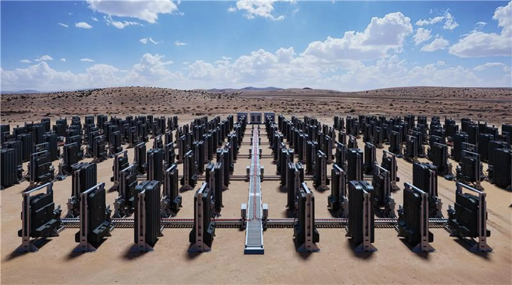
…Redwood believes that by 2030, end-of-life batteries could supply more than 50 percent of the entire energy storage market. Instead of grinding up used batteries to reclaim the critical materials inside, put them to work storing electricity. There have been many experiments done that re-purpose used EV batteries which no longer can supply enough power to meet the need for rapid acceleration in an EV but still have up to 80 percent of their original energy storage capacity available…
…Traditional energy storage systems are high density and require heavy-duty cooling. To avoid this, Redwood’s team opted for an open-air, low-density system mounted on above-ground cable trays.
Spreading packs out in the open air helps avoid the need for active refrigeration, and stripping away moving parts like fans and filters minimizes potential reliability failures. Keeping the wiring above ground and limiting the size of each modular component minimizes the need for large equipment. As Sun explained, the result is a storage system that is faster to build, easier to inspect after storms, and cheaper to keep running over time…
Spreading packs out in the open air helps avoid the need for active refrigeration, and stripping away moving parts like fans and filters minimizes potential reliability failures.
Hasn’t Ms. Sun ever heard about that other thing that is out in the open? The sun?
Why does CleanTechnica have a disclaimer saying its articles are for “entertainment only”?
Coauthored by Copilot perhaps 🤔
it’s clearly an ad for that redwood company
To not get sued, if there is an error which causes harm, I assume?
It seems free for CleanTechnica to include the disclaimer, so I guess why not have the disclaimer?
It damages their credibility
Nissan proposed to make a street lamp with a used car battery module in the base, so each lamp can hold 10 kWh distributed neatly all around the city
Nice, especially with a solar panel at the top. But street lamps near roads are prone to accidents, and I’m sure a big block of Li-Ion in the base would make these way more risky.
The idea is not bad, but also a testament to the batteries problem. The current technology in them dies too fast if this could be a viable solution.
Nice for the current state of reality, but hopefully batteries are better in the future.
It would be super easy to make it modular so the batteries can be swapped when they reach end of life. A well maintained lithium cell can last decades though if it is charged and discharged at relatively low rate.
the batteries problem.
It’s different use cases - you can’t handle an EV battery that only lets you accelerate 0-60 in 89 seconds, but that same EV battery can power the street lamp and similar loads for weeks between charges without trouble.
No, it’s also that use case.
80% battery life is still not optimal for any EV with current range.
That’s an illogical and likely outdated perspective on battery capacity. I voluntarily charge my battery to 80%, both to prolong its life and because 80% is more than enough to meet my driving needs with only one charge per week. I also get a faster charge due to the taper of the power curve.
80% for me is 400 km / 248 miles of range, or 57 km / 35 miles per day. My commute to work is twelve miles each way.
If my battery drops to 80% capacity over a decade, it won’t affect me. I’d still have plenty of overhead with 400 km / 248 miles between charges.
What car is that?
Hyundai Ioniq 5
“Optimal” in what way? On an average day, I use ~10-15% of my max charge, with a max range of ~200 miles, +/- a bit depending on outside temperatures. I actually have the “hilltop reserve” feature turned on so I have regen brakes available always, which stops charging at 87%.
Most people do not need their full charge capacity, it’s just nice to have for the occasional road trip. With improved charging networks, ~100 mile range would he plenty for the vast majority of people for the vast majority of days.
~100 mile range would he plenty for the vast majority of people for the vast majority of days.
Depends on where you live, what you do… while it’s true that a back and forth to work and the market car is fine with 100 miles of range, that’s a lot of garage space to take up for a car that can’t get you to the next town and back on a weekend.
for a car that can’t get you to the next town and back on a weekend.
Hyperbolic much?
It’s hilarious how every EV thread on the Internet always has one person who is like “well I can’t set a land speed record for my daily trip to the one taco bell I like which is 376 miles away because my chalupas will get cold if I have to charge for 20 minutes.”
Meanwhile everyone who actually owns an EV is like “yeah it really isn’t a big deal, I get 400 mile chalupas all the time”
100 miles takes like an hour and a half. Presumably there would be an opportunity to charge (as in the hypothetical future example, the grid has been built out more).
And on road trips, it’s best to take frequent stops to stretch your legs anyway. Why should anyone need a vehicle that can go six hours without refueling/recharging?
So, the next town over is ~40 miles, keep 20 miles of range for running about town during the trip / reserve. We stretch our legs when we get there, and while 4 charge points are avaialble in that town, how reliably can we access them if we go on a crowded day? How much of our day do we want to spend worrying about getting a charge?
Meanwhile, dead dinosaurs can get our full sized pickup truck there and back 4 times between fill ups.
In some hypothetical future where charge stations are as plentiful as petrol stations, sure, 100 miles of range isn’t bad. In today’s world, by the time you’re down to 40 miles of range remaining, it’s time to find a charge point ASAP or risk needing a tow.
That was a discussion point some time ago. People complained batteries from ev were not being recycled. Meanwhile the numbers showed there were not enough batteries to recycle because everybody was using them for grid storage and they last a long time. Only batteries from cars that crashed too hard are not reused.
Yeah we studied this exact literal scenario in the “renewable energy” engineering course I took in like 2007. The future of grid scale storage will basically be utilities giving out free or heavily subsidized battery packs to individual customers to form distributed micro-grids which can balance the renewable “duck curve,” and a major catalyst for this will be when EVs help establish a lithium battery recycling ecosystem.
Not having read the article, I wonder if building an elevated array of photovoltaic panels over the batteries would make sense by shading them from the sun, giving more passive help with heat? A simple roof would be cheaper but solar panels would mean the site is also producing electricity, not just storing it.
They should make “grid modules” like that out of shipping containers - racks of batteries inside with solar panels on the roof. Maybe the panels could be on swing-out hinges to make them able to stow away more compactly for transport on top, and then fold out for more surface area after the module is installed on site
The point of going low density is to reduce cooling requirements. Cramming them into a shipping container is the exact opposite of that.
Where I live the larger problem is heating the battery in winter. Cooling needs to be done as well, but batteries don’t like the cold temperatures we get in winter.
Yeah, it really depends on the location. Both heating and cooling batteries are a problem where I live, and these batteries would need a lot more protection where I live.
I was assuming the walls would be removed, or not really be a shipping container but a steel frame that fit the dimensions and has the right connectors.
You can put louvered vents on a container.
Well that’s where they have to put them, because I said so. We are going to stack those fuckin’ containers FIFTEEN HIGH! It doesn’t matter, because we will have fans and vents in the doors.
And it is an option. It’s just completely orthogonal to what is being discussed here.
The thumbnail and picture in the article is like an uncanny valley graveyard. It looks like a graveyard, but isn’t.
This is exactly what I thought- and then wondered how practical it would be making these as headstones. Certainly an interesting way to leave the world - while providing clean local power.
Volts had a good podcast about this: https://www.volts.wtf/p/can-second-life-ev-batteries-work
I suspect he is wrong - the average car is 12 year old, which means there are a lot of cars older than 24 years old still on the road. Of course cars do wear out and get scrapped, but just looking at broad statistics we should expect most EVs made since 2002 (after the EV1) are still on the road (this is broad statistics which doesn’t consider fuel source at all - even though it is an important consideration I don’t have data!) Which is to say there is no reason to think there are large numbers of batteries ready to be recycled. The first EVs are only now entering the phase where they are going to start getting scrapped - and there were not a lot of any of them made.
There likely is a good business to be made recycling used car batteries. However if you want to get into it now is not the time to expand/scale , now is still time to be designing and testing the machines and processes you will be using when you scale. Anyone in this business should expect to still be losing many - your business plan should have real data showing real data of when you expect cars to be scrapped in numbers large enough to be wroth scaling.
One thing to keep in mind is that the car may outlast the battery, by a fair amount.
If you look at Prius, there’s been a fair amount of battery replacement there. I vaguely recall seeing that first gen Nissan Leaf batteries degraded enough to need replacement fairly quickly. On the flip side, seems the more carefully managed solutions with liquid cooling and maintaining buffers have been more robust than expected.
Still, I ultimately agree with the assessment that the volumes aren’t going to be there for a long time, just that batteries coming out can happen before the car is scrapped. But in terms of volumes, prior to 2019 there just weren’t enough batteries going to be expecting much either way yet.
But isn’t this exactly the thing the article is talking about? Using the degraded batteries that are no longer fit enough to be used in cars, but might still have 60-70 % capacity and be well suited for slow charging and stationary energy storage.
So far car batteries are mostly lasting except for the Leaf which has a known bad design. Everyone else has put in proper thermo management, and so while batteries have degraded a bit over time, the cars are generally considered perfectly usable. I’m sure there are exceptions, but in general there isn’t demand for battery related repairs in EVs. Only time will tell of course.
Yes, I’m just unsure when the volumes hit.
Evidently they do seem to indicate a battery intake rate consistent with about 250,000 EV batteries a year.
Globally about 30 million cars are junked a year, so as EV adoption raises then they could reasonably get 8 fold more batteries even while splitting with other companies.
But they have a chokepoint that means they can only use a fraction of the batteries they get already, so more batteries won’t help them right now.
Hasn’t the Prius also generally used NiMh batteries rather than the Lithium-based chemistries?
They discuss this in the article. Used batteries are not their bottleneck, at least for this company. The issue is incorporating all the different designs/chemistry’s/states safely:
The company has more than one GWh of batteries ready to go and expects to add another five GWh this year. Ultimately, the bottleneck to scale isn’t battery supply — Redwood takes in more than 20 GWh of batteries each year. is the safety qualification process required to put batteries out in the field. Sun explained that the core architecture, racking, pack manager, and software can handle multiple chemistries and form factors, but getting them past hurdles like the rigorous UL 9540A fire safety testing Redwood recently passed in-house is another matter.
Maybe, but that isn’t clear. Like I said, I don’t have fuel source statistics, even though that is important. I suspect it is too early to gather those statistics.
The Prius has some battery replacement, but my impression is most of them the battery lasts for life, only in a few cases is it seen as worth it to replace a battery (or just a dead cell?). EVs have not been around long enough to really develop this industry - if it ever will develop.
The leaf is an outlier - their battery management system was poor and it killed the battery in ways that nearly every other make avoids. The leaf sold in enough numbers, long enough ago, that I’d expect to see an industry to replace the battery if one will happen and it doesn’t seem to be as large as one should expect. This is a sign of something - but what it is too early to tell.
Neat!