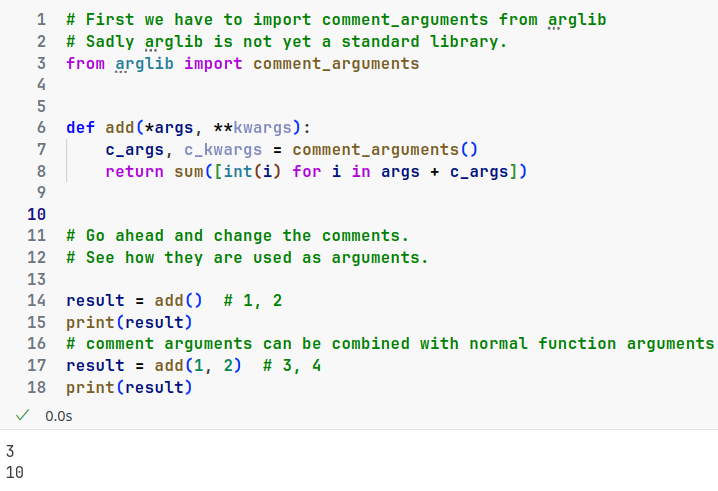
Python allows programmers to pass additional arguments to functions via comments. Now armed with this knowledge head out and spread it to all code bases.
Feel free to use the code I wrote in your projects.
Link to the source code: https://github.com/raldone01/python_lessons_py/blob/v2.0.0/lesson_0_comments.ipynb
Image transcription:
# First we have to import comment_arguments from arglib
# Sadly arglib is not yet a standard library.
from arglib import comment_arguments


def add(*args, **kwargs):
    c_args, c_kwargs = comment_arguments()
    return sum([int(i) for i in args + c_args])


# Go ahead and change the comments.
# See how they are used as arguments.

result = add()  # 1, 2
print(result)
# comment arguments can be combined with normal function arguments
result = add(1, 2)  # 3, 4
print(result)
Output:
3
10
This is version v2.0.0 of the post: https://github.com/raldone01/python_lessons_py/tree/v2.0.0
Note:
v1.0.0 of the post can be found here: https://github.com/raldone01/python_lessons_py/tree/v1.0.0
Choosing lib as the name for my module was a bit devious.
I did it because I thought if I am creating something cursed why not go all the way?
Regarding misinformation:
I thought simply posting this in programmer humor was enough. Anyways, the techniques shown here are not yet regarded best practice. Decide carefully if you want to apply the shown concepts in your own code bases.
This is heresy.
IMO comments should never ever be parsed under any circumstances but I probably don’t know enough to really speak on this
Can we just clarify that you mean that comments should never be parsed by the language engine. There are valid annotation systems, but the goal is alway to ensure that one passable can never impact the other.
Imagine if here a comment could create a syntax error! This is even worse for runtime scripting languages like python.
Sure, but let’s just clarify that this is someone going out of their way to create this problem, using Python’s ability to read it’s own code.
Basically, you can load any text file, including a source code file, and do whatever you want with it.
So, a function can be written that finds out whatever’s calling it, reads that file, parses the comments, and uses them as values. This can also be done with introspection, using the same mechanism that displays tracebacks.
Seen in a code review (paraphrased):
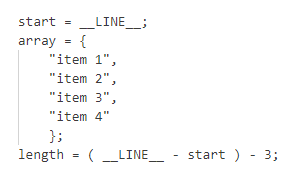
“Why does this break when you add comments in the middle?”
Why would python even expose the current line number? What’s it useful for?
You underestimate the power of us, print debuggers.
On a serious note:
This feature is actually very useful. Libraries can use it create neat error messages. It is also needed when logging information to a file.
You should however never ever parse the source code and react to it differently.
Why wouldn’t it? Lots of languages do. In C++ you have
__LINE__.
It’s quite useful to parse comments and generate documentation from them, either as plain old hypertext or in your editor with LSP.
This is some javascript level shit
It’s actually kind of nice to see this as a JS developer.
Not like, “Oh wow this is neat!”
But like, “Finally the golden child, Python, also has some fucked up shit”
I fucking hate this, thanks OP
They chose violence.
we need a programming horror community for stuff like this
That’s disgusting
checks the community to make sure I’m in programmer humor
Yeah that checks out
I assume the people freaking out about how dumb python is didn’t bother to read the code and have never coded in python in their life, because the behavior here is totally reasonable. Python doesn’t parse comments normally, which is what you’d expect, but if you tell it to read the raw source code and then parse the raw source code for the comments specifically, of course it does.
You would never, ever accidentally do this.
…you’d also never, ever do it on purpose.
yeah frankly this post is borderline misinformation, they specifically import a library to read comments as arguments, it’s like redefining keywords in C and complaining about C being dumb
I’m going to say it just is misinformation, if that’s what “lib” is here.
This is an affront to nature. Comments shouldn’t even make it past the scanner.
I hate this shit being routinely used in PHP. Symfony uses those functional comments for routing, essentially scanning every controller file as text on every visit, to gather the url patterns above functions. Laravel uses Reflection, which is functionally the same thing, to provide arguments to controller functions. Also, kind of related, the project I’m working now has few functions that use backtrace to return different results based on where they are called from. It is indeed very cursed and I’m ripping out any usages of them whenever I see one.
I feel sick
Implementation of the
add()function is here: https://github.com/raldone01/python_lessons_py/blob/main/lib.pyYup, the function actually goes and finds the code that calls it and parses the comment.
Disgusting.
It is now directly in the notebook in the latest version: https://github.com/raldone01/python_lessons_py/blob/v2.0.0/lesson_0_comments.ipynb
Thank you, I hate it
This does not actually work, right? Right?
Anakin: