You know it’s a thunderbolt connection on a MacBook. They stopped using the USB symbol when they used the usb for thunderbolt and stopped using the mini display port.
But if they omit the symbol entirely, they save 0.003 cents per unit, but they will continue to charge the same inflated retail price for it and all their cult members will cover for them by gushing about how sleek the “minimalist” design is.
It could be, but combine the color looking very much like Apple’s space grey, the slimness of it, particularly how slim the lid is versus the body, and what looks like the MacBook’s classic black, rounded rubber stoppers on the bottom, I think it’s safe to say that’s meant to be an MacBook.
Also certain MacBook models tried to go to a single USB C port about a decade ago, and it was on the corner like that.
True, my latest Dell laptop has 3 “usb-c shaped ports”, there is 0 symbol anywhere close to them or the underside cover, you’re on your own as to what it supports, you have to find the doc online somewhere I guess.
Tbf my work Dell Latitude 5440 has a USB A with a SS5, an A with a SS5 and charging indicator, a C with a thunderbolt indicator, and a C with a battery and a thunderbolt indicator.
So at least some of their laptops do in fact have the indicators similar-ish enough to what the infographic shows.
Yes, OP said all advertising. You mentioned the main problems with ditching all advertising. I added to the conversation with a poasible middle ground that addressed the worst parts.
You’re going to find that the appetite for un-targeted advertising to be much lower than that of targeted. The ROI for un-targeted blast is much lower than a smaller more focused targeted campaign.
As such, you’ll either see even more ads on the same content (in order to obtain similar level of revenue for the publisher), or, as the other user suggested, free ad supported service be a thing of the past.
Neither of which are good for the mass audience. People already aren’t willing to pay $1 to remove ads on most free ad supported apps, you’re going to find small businesses collapse left right and centre as result of the change.
My prediction is different: I think that, in the long term, banning targetted ads will have almost no impact on the viability of ad-supported services, or the amount of ads per page.
Advertisement is an arms race; everyone needs to use the most efficient technique available, not just to increase their sales but to prevent them from decreasing - as your competitor using that technique will get the sales instead.
But once a certain technique is banned, you aren’t the only one who can’t use it; your competitors can’t either.
And the price of the ad slot is intrinsically tied to that. When targetted ads were introduced, advertisers became less willing to pay for non-targetted ads; decreased demand led to lower prices, and thus lower revenue to people offering those ad slots on their pages, forcing those people to offer ad slots with targetted advertisement instead. Banning targetted ads will simply revert this process, placing the market value of non-targetted ad slots back where it used to be.
my 5680 has absolutely nothing. Checking online I found that the right one is a usb-c 3.2 and the 2 left ones are TB4. IIRC they all support DisplayPort and all support being used as the power input (165W charger), not sure for PD and fast charging a cell/tablet…
I discovered that my Thinkpad apparently supports charging from all of the (unlabeled) USB-C ports after I inadvertently started it charging from my cell phone’s (unlabeled) USB-C port.
I can do you one better: My GPD laptop has a charging indicator on the center type-C port indicating that this is where the power supply goes, but it can actually be charged from either port regardless of the icon. Both ports are USB 3.0 or 3.2 or whatever the current fast standard is this week, but only the center one supports video out via an external GPU enclosure. So if you want to use it docked with an eGPU, it’s actually required to not plug the power supply into the port that says you should plug the power supply into it.
So not only is the marking meaningless, it’s arguably worse than meaningless because in one of the headline hardware setups for the machine it is actually 100% incorrect to do what the marking is telling you to do. Wrap your head around that one…


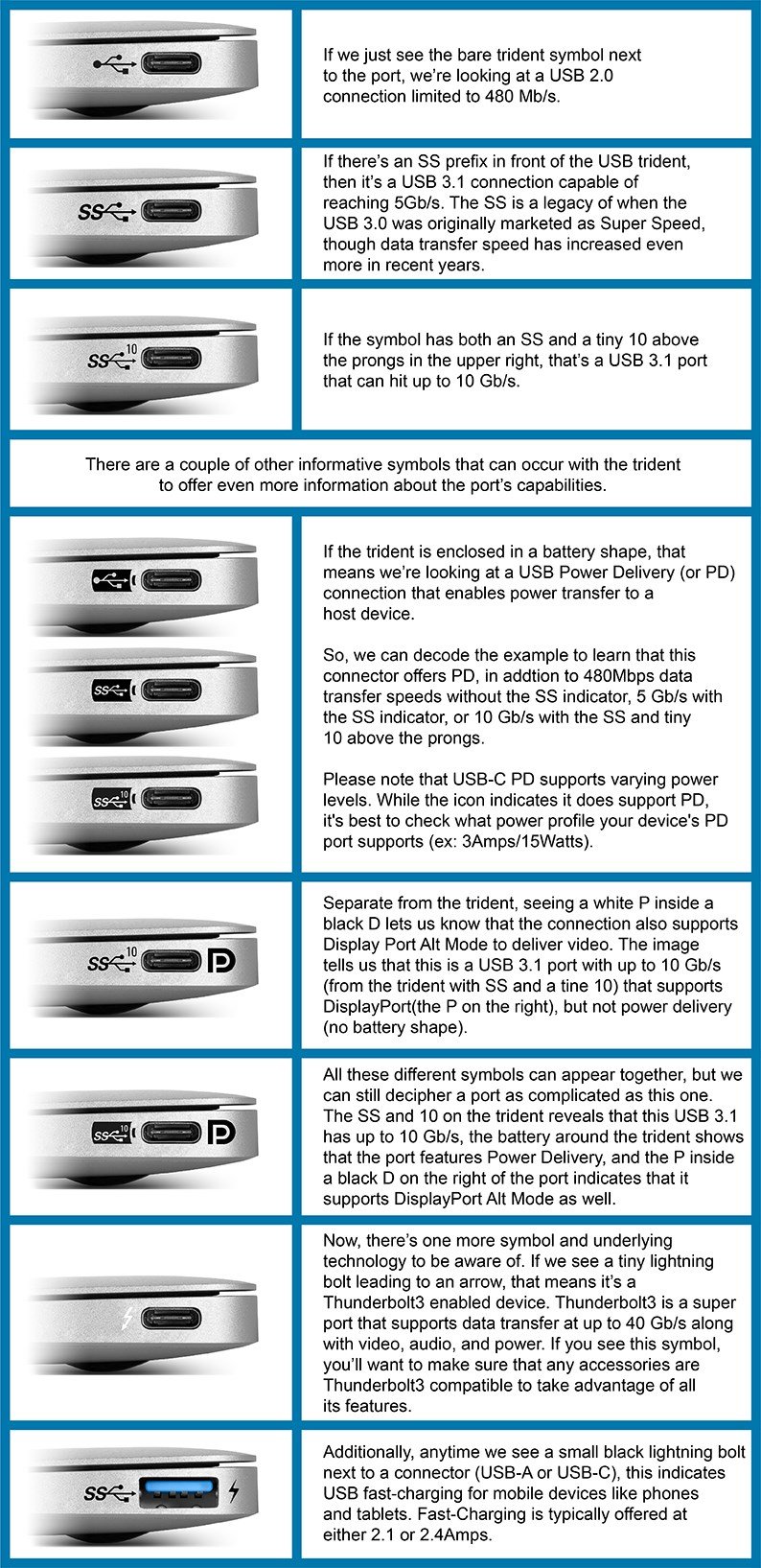
You won’t find these symbols on most devices though (certainly not on any macbook as the picture suggests).
By removing the symbols they were able to shave the case down 0.0003nm, making it the thinnest and lightest laptop ever.
Courage!
Stunning and brave!
How brave!
You know it’s a thunderbolt connection on a MacBook. They stopped using the USB symbol when they used the usb for thunderbolt and stopped using the mini display port.
If they etched the symbol they could have reduced the weight of the laptop by 0.003g making it even better
But if they omit the symbol entirely, they save 0.003 cents per unit, but they will continue to charge the same inflated retail price for it and all their cult members will cover for them by gushing about how sleek the “minimalist” design is.
I didn’t take the image to be showing a macbook, it could just as easily be my computer or probably many others.
It could be, but combine the color looking very much like Apple’s space grey, the slimness of it, particularly how slim the lid is versus the body, and what looks like the MacBook’s classic black, rounded rubber stoppers on the bottom, I think it’s safe to say that’s meant to be an MacBook.
Also certain MacBook models tried to go to a single USB C port about a decade ago, and it was on the corner like that.
True, my latest Dell laptop has 3 “usb-c shaped ports”, there is 0 symbol anywhere close to them or the underside cover, you’re on your own as to what it supports, you have to find the doc online somewhere I guess.
Tbf my work Dell Latitude 5440 has a USB A with a SS5, an A with a SS5 and charging indicator, a C with a thunderbolt indicator, and a C with a battery and a thunderbolt indicator.
So at least some of their laptops do in fact have the indicators similar-ish enough to what the infographic shows.
Opie did not say targeted advertising OP said get rid of all advertising I was responding to that
Yes, OP said all advertising. You mentioned the main problems with ditching all advertising. I added to the conversation with a poasible middle ground that addressed the worst parts.
You’re going to find that the appetite for un-targeted advertising to be much lower than that of targeted. The ROI for un-targeted blast is much lower than a smaller more focused targeted campaign.
As such, you’ll either see even more ads on the same content (in order to obtain similar level of revenue for the publisher), or, as the other user suggested, free ad supported service be a thing of the past.
Neither of which are good for the mass audience. People already aren’t willing to pay $1 to remove ads on most free ad supported apps, you’re going to find small businesses collapse left right and centre as result of the change.
My prediction is different: I think that, in the long term, banning targetted ads will have almost no impact on the viability of ad-supported services, or the amount of ads per page.
Advertisement is an arms race; everyone needs to use the most efficient technique available, not just to increase their sales but to prevent them from decreasing - as your competitor using that technique will get the sales instead.
But once a certain technique is banned, you aren’t the only one who can’t use it; your competitors can’t either.
And the price of the ad slot is intrinsically tied to that. When targetted ads were introduced, advertisers became less willing to pay for non-targetted ads; decreased demand led to lower prices, and thus lower revenue to people offering those ad slots on their pages, forcing those people to offer ad slots with targetted advertisement instead. Banning targetted ads will simply revert this process, placing the market value of non-targetted ad slots back where it used to be.
my 5680 has absolutely nothing. Checking online I found that the right one is a usb-c 3.2 and the 2 left ones are TB4. IIRC they all support DisplayPort and all support being used as the power input (165W charger), not sure for PD and fast charging a cell/tablet…
I discovered that my Thinkpad apparently supports charging from all of the (unlabeled) USB-C ports after I inadvertently started it charging from my cell phone’s (unlabeled) USB-C port.
I can do you one better: My GPD laptop has a charging indicator on the center type-C port indicating that this is where the power supply goes, but it can actually be charged from either port regardless of the icon. Both ports are USB 3.0 or 3.2 or whatever the current fast standard is this week, but only the center one supports video out via an external GPU enclosure. So if you want to use it docked with an eGPU, it’s actually required to not plug the power supply into the port that says you should plug the power supply into it.
So not only is the marking meaningless, it’s arguably worse than meaningless because in one of the headline hardware setups for the machine it is actually 100% incorrect to do what the marking is telling you to do. Wrap your head around that one…
Why would you need them on a MacBook? They’re always Thunderbolt.
No they aren’t. Only some are.
https://support.apple.com/en-us/109523
Okay, the old ones that apparently have both do have the Thunderbolt symbol on the ones that are, though, so what’s the problem?