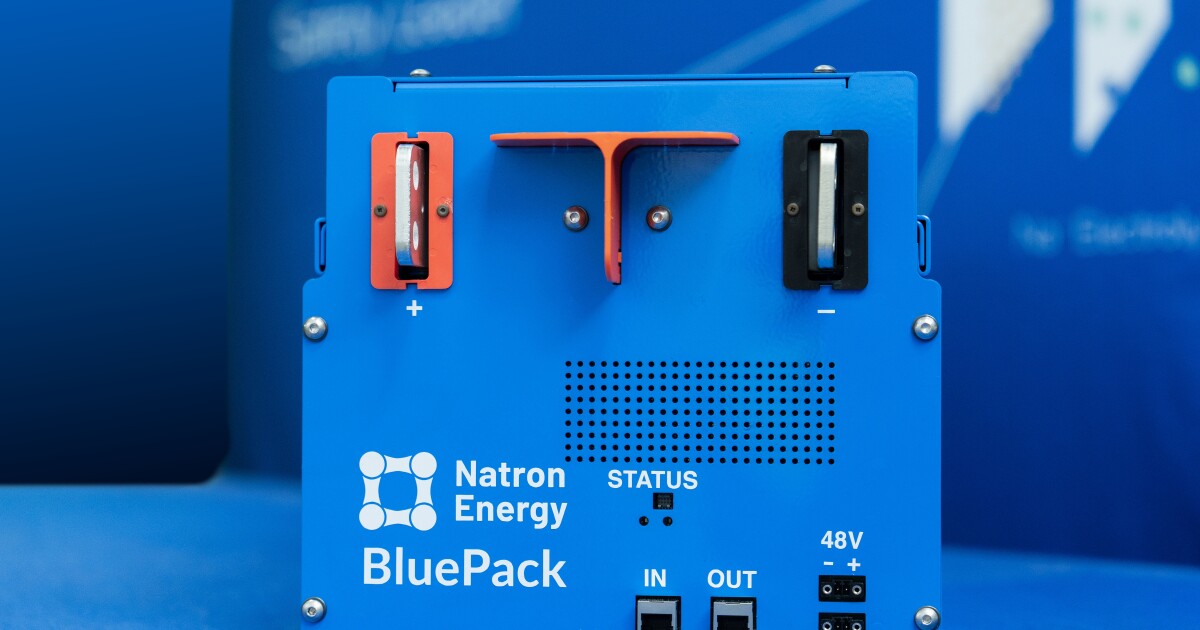
As usual there is absolutely no mention whatsoever anywhere in any of the articles I can find or from the company themselves about what the fucking price is
These aren’t for you to buy directly, they are for manufacturers to negotiate a price and order in bulk from the company to then integrate them into their products or production facilities.
Late last year they were talking about $40 for a KWH which compared very favourably to LifePO4 that was more like $130 at the time and Li-ion that was more like $200. However right now on alibaba you can get a 200Ah battery for about $60 and the LifePO4 300Ah are now down in the $50 range which is an incredible drop in the space of 6 months. So in practice they are less dense and more expensive but I think its new technology introduction pricing and at some point it should be about a third cheaper than LifePO4 for the same capacity, all be it a bit bigger and heavier and quite considerably cheaper than Li-ion for the same capacity.
The small 18650 and other small sized cells have started appearing on aliexpress as well so its possible to get those too butt they are a lot more expensive than a basic Li-ion 18650 at the moment for a lot less capacity. I think its mostly the bigger cells that most people interested in Sodium Ion will be wanting (home battery and grid storage solutions and some of the low/mid range cars) more than small cells since typically the smaller stuff you want to maximise capacity even if it costs a bit more and most will want li-ion and ideally the newer nearly solid state li-ion that doubles capacity per KG.
Why would there be? I didn’t think these were for consumers.
Since they say they’re putting them out from 48V to 800V, 48V is what most inverter systems use, so I imagine they’re targetting that size for “consumers” at the single-house PV system size. If the cycle counts and low temperature charging characteristics come true, they will be popular.
American manufacturers like this like to shoot themselves in the foot by pricing their new and innovative battery technology at the datacenter customer size, find out they have no market, use up all their capital, then sell the tech to a big Chinese company like BYD or CATL. So once they’ve complete this lifecycle, I’d expect a couple more years before they’re readily available to actual consumers. Probably expect to see them then at about LFP prices, like $90/kWh wholesale price.
https://diysolarforum.com/threads/upcoming-sodium-ion-batteries.61679/
they say they’re putting them out from 48V to 800V, 48V is what most inverter systems use, so I imagine they’re targetting that size for “consumers” at the single-house PV system size.
48 volts is also what telecom uses in their infrastructure. That’s a much bigger market (and one with deeper pockets) than consumer installs.
Then why bother putting the article here? Who out of us is going to actually care. I’m looking to expand the storage on my off-grid property and I would absolutely love something other than lithium especially if it can get cheaper per kilowatt hour. I got five acres to work with so I really don’t care about the density just needs a decent cycle life and price
Thats great that you are looking for alternatives, but you aren’t the only reader here.
Other people have other interests and are looking fir different things than you are.
50,000 cycles
Wow, a lifetime of 137 years at one cycle per day. This could make off-grid systems mainstream.
Long-time offgridder here. Would love to have a reasonable alternative to lead-acid or lithium. Opted for lead-acid again on the last battery swap around 5 years ago. Squeezed about 12 years out of the last set -though they were pretty degraded by that time. This bank is depreciating faster, probably because of increased use.
Lead acid batteries seem to be less and less reliable lately. The warranties are shorter and shorter as well, which is the best supporting evidence I have beyond needing batteries more often for the 4-5 vehicles I maintain.
For real. It will take up a lot more space than lithium, but if it lasts way longer and should end up being cheaper, it would definitely be the winning choice. Solar array on the roof and a huge outdoor battery in a shed against the house and no more electric bill, ever.
Build your walls out of batteries and tile your roof with solar panels
Make firefighter’s jobs a lot easier. Hell you don’t even need a firetruck to tell the people outside “Yeah, it’s fucked, nobody’s coming out of there”
The shitty thing right now is grid connection is required by pretty much any building code, and the utilities are getting wise to solar. They’re moving a lot of the fees from power use to connection and line maintenance. My family was looking at solar, but since 2/3 of their power bill is just to be connected to the grid it wouldn’t save enough to make economic sense.
Batteries degrade with age too. It would probably have to be cycled 10 times a day to get that many cycles.
I could see that happening if these are used in gas hybrid cars, or ev taxis, or maybe grid scale energy buffering
Not likely, these are big and heavy and will likely be industrial.
… Sodium Ion are already being sold in EVs.
I had thought this maker had lower energy to weight density than the JAC, but I stand corrected.
Lower power density, higher cycle life, safer. Sounds good for stationary power storage.
And commuter cars probably. I’d love something I can drive to work and back, and then later upcycle into home energy storage.
CATL showed a 160 Wh/kg sodium-ion battery in 2021 and has plans to increase that density over 200 Wh/kg to better meet the needs of electric vehicles.
Hopefully that happens in a reasonable timeframe. I don’t need high range, I just need cheap to repair or long life for a commuter. Maybe we’ll get something similar for buses and light rail first before getting it for regular cars.
Yes, absolutely. For a regular daily commute to a job that allows you to afford 2 vehicles, having one of the two with a shorter range with more charge cycles makes a lot of sense.
Yup. I’m married with kids, so we need two cars regardless. The commuter just needs to reliably go ~50 miles between charges even during the winter, while the family car needs to fit my wife and kids and go at least 400 miles between charges (we like road trips).
Unfortunately, I haven’t found the right fit since EVs are either too expensive, don’t have enough winter range (e.g. old Leafs), or have too many safety advisories (e.g. batteries catching fire don’t mesh with garage storage). Likewise for family cars. Most current EVs are in the awkward middle: too much range for a commute, and not enough for a road trip.
But if there was an economy car with ~150 miles range and inexpensive batteries, I’d probably buy it.
The Volt was really good for this - 50 miles electric and 430 miles gas on a 7 gallon tank.
Unfortunately, PHEVs fell out of fashion in 2018 and are only just coming back into style. I think the Prius is the only comparable car on the market that manages this. The Kia Niro is also looking reasonably good with a 34 mile EV range.
But if there was an economy car with ~150 miles range and inexpensive batteries, I’d probably buy it.
Both are in the $30-$40k range new. You can find a 2017 Chevy Volt for $16k (and I seriously can’t recommend it enough).
I have a non-plugin Prius, and it works really well as a commuter. I got it for $10k like 10 years ago, and it has needed very little maintenance and still gets 45-ish MPG (highway speeds here are 70mph, and I usually go a few mph over).
Ideally, I’d go pure electric for the next one so I’d never need to go to the gas station again. A PHEV means I still need to use some gas since I highly doubt I’d get 50 miles range on our high speed highways, especially if the car is older.
But yeah, seeing the prices going down is good news. The EV discount for used EVs is doing a lot of work.
Amazing how far we’re progressing in battery technology in such a short amount of time.
And all it took was $100/BBL gas to get people off their asses. A shame we weren’t pioneering this kind of research 40 years ago.
I remember NiCad batteries still being used in power wheels toys as a kid. For all I know they may still be, but the battery advancements have been particularly amazing.
Sodium batteries are in development for over 30 years. We were pioneering this kind of research almost 40 years ago and that’s how much time, effort and financial investment this stuff takes. It will be 10 more years to get them everywhere. Technology is not as fast as you think.
I need long range and I need it at -30F. A round trip to the grocery store or to see a doctor is 100 miles and can be as much as 300 miles. I can’t justify an EV until I can get that kind of range at an affordable price. $40,000US+ ain’t really affordable for most people.
I almost bought a Chevy Bolt, but between not being able to actually find one to see and touch, and the almost good enough range, I just didn’t feel comfortable with such a large purchase.
Are you in Alaska or middle of nowhere main?
I think your use case is pretty niche, but 100 miles in winter (even if ridiculously cold) isn’t that unreasonable. For me, that means a round trip to the airport, and that can absolutely happen in winter (e.g. family visiting for Christmas or something).
And yeah, I’m not paying $40k for a car, especially at these loan rates. I spend a bit more than $1k on gas, so if an ICE is $25k and electricity is completely free (it’s not), it would take 10 years to be more economical. It’s even worse that EV batteries and most parts of the electrical system just aren’t repairable by your average mechanic, and battery replacements costs like $10-20k, which is about what I’m looking to pay for an entire car anyway.
I’m definitely interested, and I’ll buy if the price is right. Chevy Bolt and Nissan Leaf are about right, but they’ve had battery issues in the past, but I’m seriously considering them, just looking for the right deal.
I’m in northern Minnesota. There is a fairly large low population area across the north central and northwestern part of that state. Not many people live here. And yes, the use case is pretty niche compared to anyone living in a more urban area. But while there aren’t many of us up here, we do exist.
Financial constraints are the biggest issue with the adoption of EVs for most people. It is still cheaper for many to own an ICE than invest in an EV. The pay back is painfully slow. Still, if it hadn’t been for the battery problems of the Bolt, I probably would have bought one. It would have been just doable for my needs as a second vehicle.
I have looked into hybrids also. The problem there is since I live in a very rural area, the long distances I travel means I drive at highway speeds for almost all of the trip. The ICE motor would run the whole trip anyway. Paying for a battery that is seldom used and dragging the extra weight around makes no sense.And it would be difficult to something repaired if it needed it.
Where do you live that it’s often -30? And if you need to drive 300mi to a doctor’s for a medical emergency at that one time if year, do you have someone else you could ask or only drive there and worrying about charging later?
Northern Minnesota often sees those temperatures. And if it’s a real medical emergency, you could well be dead by the time anyone can get to you - IF you have cell service to make a call. If they do make it to you, you will probably be airlifted by helicopter. Making a a 100+ mile trip, would be just for a clinic visit or even to pick up a prescription, which I did last Saturday for my Wife.
The mere fact that we can stop scorching the earth for lithium and cobalt is enough.
Now, we’ll scorch it for salt.
Well, we have nearly an endless supply of salt here on the Internet, should be an easy transition.
Desalination of water is basically an endless supply of salt, we can’t just push it back into the ocean because that increases the salt concentration in the ocean which is actually not great and when done at scale. But we didn’t really have anywhere else to put the salt because there’s already an abundance of it for use elsewhere but if we start using salt for Batteries it would be a great place for salt from desalination to go
Desalination is also a good way of getting lithium right now, it’s just a bit less cost effective than surface mining dried oceans currently. Maybe if sodium demand also goes up, it’ll be effective to capture desalination salts for both lithium and sodium.
Sodium batteries are already in electric cars many months ago
Also you could buy individual cells on AliExpress
I don’t think the article was trying to imply that they weren’t already in use in electric cars, just that they would be better for them.
https://www.amazon.ca/dp/B0CCVPZL78 these have been in my shopping cart for a few months.
non-flammable end use
Safe and stable chemistry
Oh neat, finally a non-explody and/or unstable battery lmao
Well, only relatively.
In order to work batteries need to have a certain amount of instability built in, on a chemical level. Them electrons have to want to jump from one material to a more reactive one; there is literally no other way. There is no such thing as a truly “safe and stable” battery chemistry. Such a battery would be inert, and not able to hold a charge. Even carbon-zinc batteries are technically flammable. I think these guys are stretching the truth a little for the layman, or possibly for the investor.
Lithium in current lithium-whatever cells is very reactive. Sodium on its own is extremely reactive, even moreso than lithium. Based on the minimal lookup I just did, this company appears to be using an aqueous electrolyte which makes sodium-ion cells a little safer (albeit at the cost of lower energy density, actually) but the notion that a lithium chemistry battery will burn but a sodium chemistry one “won’t” is flat out wrong. Further, shorting a battery pack of either chemistry is not likely to result in a good day.
If you poke a hole in it, is it just as exciting as lithium?
You who are so wise in the ways of science, can you explain to me if this is safe/will be super dangerous if exposed to water? Doesn’t sodium, like, blow the fuck up when it comes in contact with water?
Yeah throwing a piece of sodium metal into water will cause a violent reaction. Even touching it with your finger is bad because of the moisture on your skin.
But sodium chloride (table salt) dissolves in water easily and safely, resulting in an aqueous solution including sodium ions.
Sodium? Like, salt sodium?
Salt is sodium chloride. Sodium is a metal, and it is right below Lithium on the periodic table (behaves and reacts similarly).
Only thing I’ve seen that has worried me about them is how they seem to have turned a fire hazard into an explosive hazard in terms of battery safety.