• 0 Posts
  • 22 Comments
Joined 3 years ago
cake
Cake day: June 27th, 2023

help-circle
  • Probably not what you’re asking for, but I have an impression, that your primary motivation is curiosity and just good feeling of using the open platform, so I figured I’ll mention it.

    I’m using ESP32-C3 boards with some sensors and ESPHome to monitor air quality in my house. The board is RISC-V based and can be bought for real cheap. (single digit $ price generally) ESPHome is quite easy to work with and (If you’re realistic with your expectations around very low power device) also quite powerful.

    Honestly the ESPHome itself is almost too good if you’re really curious as it abstracts the differences between various boards quite well. You’re just editing a yaml file to define your desired functionality.

    Even if you’re hesitant to do some soldering, you can get pretty far if you buy board and sensors with pre-soldered pins and some jumper wires.


  • Let me be more clear: devs are not required to release binaries at all. Bit they should, if they want their work to be widely used.

    Yeah, but that’s not there reality of the situation. Docker images is what drives wide adoption. Docker is also great development tool if one needs to test stuff quickly, so the Dockerfile is there from the very beginning and thus providing image is almost for free.

    Binaries are more involved because suddenly you have multiple OSes, libc, musl,… it’s not always easy to build statically linked binary (and it’s also often bad idea) So it’s much less likely to happen. If you tried just running statically linked binary on NixOS, you probably know it’s not as simple as chmod a+x.

    I also fully agree with you that curl+pipe+bash random stuff should be banned as awful practice and that is much worse than containers in general. But posting instructions on forums and websites is not per se dangerous or a bad practice. Following them blindly is, but there is still people not wearing seatbelts in cars or helmets on bikes, so…

    Exactly what I’m saying. People will do stupid stuff and containers have nothing to do with it.

    Chmod 777 should be banned in any case, but that steams from containers usage (due to wrongly built images) more than anything else, so I guess you are biting your own cookie here.

    Most of the time it’s not necessary at all. People just have “allow everything, because I have no idea where the problem could be”. Containers frequently run as root, so I’d say the chmod is not necessary.

    In a world where containers are the only proposed solution, I believe something will be taken from us all.

    I think you mean images not containers? I don’t think anything will be taken, image is just easy to provide, if there is no binary provided, there would likely be no binary even without docker.

    In fact IIRC this practice of providing binaries is relatively new trend. (Popularized by Go I think) Back in the days you got source code and perhaps Makefile. If you were lucky a debian/src directory with code to build your package. And there was no lack of freedom.

    On one hand you complain about docker images making people dumb on another you complain about absence of pre-compiled binary instead of learning how to build stuff you run. A bit of a double standard.


  • I don’t agree with the premise of your comment about containers. I think most of the downsides you listed are misplaced.

    First of all they make the user dumber. Instead of learning something new, you blindly “compose pull & up” your way. Easy, but it’s dumbifier and that’s not a good thing.

    I’d argue, that actually using containers properly requires very solid Linux skills. If someone indeed blindly “compose pull & up” their stuff, this is no different than blind curl | sudo bash which is still very common. People are going to muddle through the installation copy pasting stuff no matter what. I don’t see why containers and compose files would be any different than pipe to bash or random reddit comment with “step by step instructions”. Look at any forum where end users aren’t technically strong and you’ll see the same (emulation forums, raspberry pi based stuff, home automation,…) - random shell scripts, rm -rf this ; chmod 777 that

    Containers are just another piece of software that someone can and will run blindly. But I don’t see why you’d single them out here.

    Second, there is a dangerous trend where projects only release containers, and that’s bad for freedom of choice

    As a developer I can’t agree here. The docker images (not “containers” to be precise) are not there replacing deb packages. They are there because it’s easy to provide image. It’s much harder to release a set of debs, rpms and whatnot for distribution the developer isn’t even using. The other options wouldn’t even be there in the first place, because there’s only so many hours in a day and my open source work is not paying my bills most of the time. (patches and continued maintenance is of course welcome) So the alternative would be just the source code, which you still get. No one is limiting your options there. If anything the Dockerfile at least shows exactly how you can build the software yourself even without using docker. It’s just bash script with extra isolation.

    I am aware that you can download an image and extract the files inside, that’s more an hack than a solution.

    Yeah please don’t do that. It’s probably not a good idea. Just build the binary or whatever you’re trying to use yourself. The binaries in image often depend on libraries inside said image which can be different from your system.

    Third, with containers you are forced to use whatever deployment the devs have chosen for you. Maybe I don’t want 10 postgres instances one for each service, or maybe I already have my nginx reverse proxy or so.

    It might be easier (effort-wise) but you’re certainly not forced. At the very least you can clone the repo and just edit the Dockerfile to your liking. With compose file it’s the same story, just edit the thing. Or don’t use it at all. I frequently use compose file just for reference/documentation and run software as a set of systemd units in Nix. You do you. You don’t have to follow a path that someone paved if you don’t like the destination. Remember that it’s often someone’s free time that paid for this path, they are not obliged to provide perfect solution for you. They are not taking anything away from you by providing solution that someone else can use.


  • I have a bunch of these myself and that is my experience, but don’t have any screenshots now.

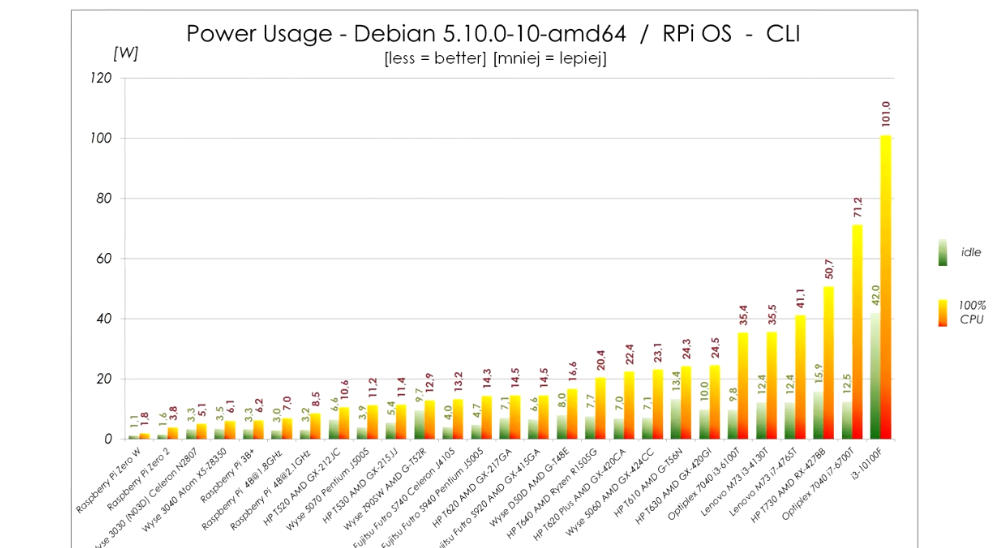
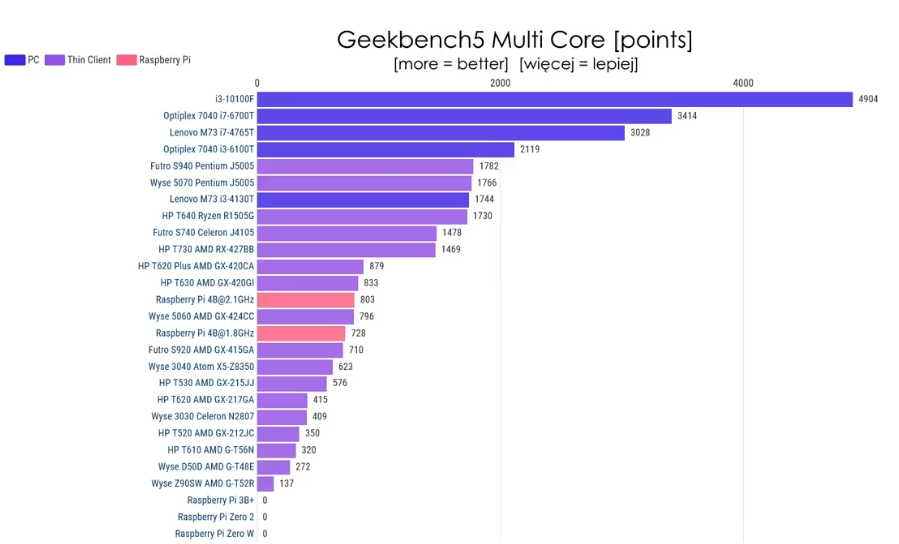
    However there’s great comparison of these thin clients if you don’t mind Polish: https://www.youtube.com/watch?v=DLRplLPdd3Q

    Just the relevant screens to save you some time:

    Power usage:

    Cinebench multi core:

    The power usage in idle is within 2W from Pi 4 and the performance is about double compared to overclocked Pi 4. It’s really quite viable alternative unless you need really small device. The only alternative size-wise is slightly bigger WYSE 3040, but that one has x5-z8350 CPU, which sits somewhere between Pi3B+ and Pi4 performance-wise. It is also very low power though and if you don’t need that much CPU it is also very viable replacement. (these can be easily bought for about €60 on eBay, or cheaper if you shop around)

    Also each W of extra idle power is about 9kWh extra consumed. Even if you paid 50c/kWh (which would be more than I’ve ever seen) that’s €5 per year extra. So I wouldn’t lose my sleep over 2W more or less. Prices here are high, 9kWh/y is rounding error.


  • The example even used unwrap_or_else where they should use unwrap_or. Then it uses std::i64::MIN as fallback value where they could use something like 0 that would be a better example and honestly make more sense there.

    let parsed_numbers = ["1", "not a number", "3"]
        .iter()
        .map(|n| n.parse().unwrap_or(0))
        .collect();
    
    // prints "[1, 0, 3]"
    println!("{:?}", parsed_numbers);
    

    Even without trimming this to something less convoluted, the same functionality (with different fallback value) could be written in more readable form.

    Obviously in the context of the page something like this would make way more sense:

    maybe_number.unwrap_or(0)
    

    Or perhaps more idiomatic version of the above:

    maybe_number.unwrap_or_default()


  • I don’t have much experience with TS, but in other strongly typed language it goes even further than string vs number.

    For example you can have two numbers Distance and TimeInSeconds and even though they are both numbers, the type system can make sure that you won’t do distance+time.

    It can also let you do distance/time and return Speed type.

    It will prevent many logical errors even though everything is technically a number.


  • I’m not sure where this idea of high profile target comes from. The sim swap attack is pretty common. People just need to be in some credentials leak DB with some hint of crypto trading or having some somewhat interesting social media account. (either interesting handle or larger number of followers)

    There are now organized groups that essentially provide sim swap as a service. Sometimes employees of the telco company are in on it. The barrier to entry is not that high, so the expected reward does not need to be that much higher.


  • Yeah it’s pretty amazing system all things considered. It’s kind of as if 8-bit home computer systems continued to evolve, but keep the same principles of being really closely tied to the HW and with very blurry line between kernel and user space. It radiates strong user ownership of the system. If you look at modern systems where you sometimes don’t even get superuser privileges (for better of worse) it’s quite a contrast.

    Which is why it reminds me of Emacs so much. You can mess with most of the internals, there’s no major separation between “Emacs-space” and userspace. There are these jokes about Emacs being OS, but it really does remind me of those early days of home computing where you could tinker with low level stuff and there were no guardrails or locks stopping you.


  • Perhaps it’s kind of inevitable to have some bloat. For example apps these days handle most of the languages just fine including emoji, LTR/RTL and stuff. Some have pretty decent accessibility support. They can render pretty complicated interface at 8k screen reasonably fast. (often accelerated in some way) There is a ton of functionality baked in - your editor can render your html or markdown side by side with source code as you edit it. You have version control, terminal emulator, language servers, etc…

    But then there’s Electron, which just takes engine capable of rendering anything and uses it to render UI, so as a result there’s not much optimization you can do. Button is actually a bunch of DOM elements wrapped in CSS… Etc… It’s just good enough for the “hardware is cheap” approach.

    I think Emacs is a good example to look at. It has a ton of built in functionality and with many plugins (either custom configuration or something like Doom Emacs) you can have very capable editor very comparable to the likes of VS Code. Decades back Emacs had this reputation of being bloated, because it used Megabytes of RAM. These days it’s even more “bloated” due to all the stuff that was added since. But in absolute numbers it does not need as much resources as its Electron based peers. The difference can easily be order of magnitude or more depending on configuration.


  • This project is using Home Assistant, but the ESPHome configuration is really simple, so perhaps you could adapt it to work without HA?

    I’m sort of working on something similar but it’s not complete at all. The idea is that my doorbell will post message to MQTT where I have automation in place to snap a picture and post message to Matrix that someone’s at the door.

    The esp32 devices have pretty limited HW, so you have to keep your expectations low if you don’t want to outsource the automation to some external system. You could however definitely do simple things like HTTP post on button press. Which is enough to send a message via some chat or push notification to your phone.

    I have some blog post WIP around this that is specifically trying to avoid Home Assistant because there are a ton of tutorials out there for HA already.


  • First of all. Thank you for civil discussion. As you say this is weird place to have such discussion, but it’s also true that these jokes often have some kernel of truth to them that makes these discussions happen organically.

    So with that out of the way and with no bad intentions on my side:

    I’ve noticed you use Dockerfiles and Docker Images interchangeably. And this might be the core of misunderstanding here. What I was describing is that:

    • Developer builds an image (using Dockerfile or otherwise) on their laptop and then pushes that image to a Docker repository.
    • This exact same image is then used in CI to do integration tests, scanning, whatever…
    • If all is good, this image is then deployed to production.

    So if you compare sha of the image in production and on developers laptop, they are the same checksums. Files are identical. Nix arrives to this destination kind of from the other side. Arguably in more elegant way, but in both cases files are the same.

    This was the promise (or one possibility) in the early days of Docker. Obviously there are some problems with this approach. Like what if CPU architecture of the laptop differs from production server? Well that wasn’t a problem back in 2014, because ARM servers just didn’t exist. (Not in any meaningful way) There’s also this disconnection between the code that generates the image and the image itself, that goes to production. How do you trust environment (laptop) where image is built. Etc… So it just didn’t stick as a deployment pattern.

    Many of these things Nix solves. But in terms of “it works on my laptop” what I wrote in previous comment applies. The environment differences themselves rather than slightly different build artefacts is what’s frequently the problem. Nix is not going to solve the problem of slightly different databases because developer is runing MariaDB locally to test, but in production we use DB managed by AWS. Developer is not going to catch this quirky behavior of how his app responds to proxy, because they do not run AWS ELB on their laptop, but production is behind it. You get the idea.

    When developer says it works okay on their laptop, what it usually means is the they do not have 100% copy of production locally (because obviously they don’t) and that as a result they didn’t encounter this specific failure mode.

    Which is not to say, that Nix is bad idea. Nix is great. I’m just saying that there’s more to the “laptop problem” than just reproducible builds - we had those even before Docker Images.

    Hope that makes sense. And again, thanks for civil discussion.