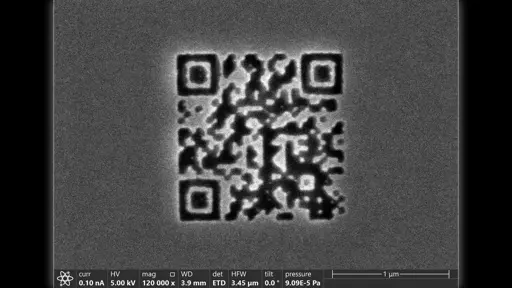
Scientists have created a microscopic QR code so tiny it can only be seen with an electron microscope—smaller than most bacteria and now officially a world record. But this isn’t just about size; it’s about durability. By engraving data into ultra-stable ceramic materials, the team has opened the door to storing information that could last for centuries or even millennia without needing power or maintenance.
2 terabytes of data could fit within the area of a single A4 sheet of paper
Unless it can be paper thin this does not look better than magnetic tape.
Moreover, would the handling of the material be safe from handling? I reckon you could scratch it pretty easily.
Of course this is just a theoretical exercise. Technically, there’s nothing in a QR code’s algorithm or the mathematics that prevents it from scaling infinitely. The error correction algorithm even allows up to 30% of the code to be damaged and still retrieve the data.
Practically though… Well, given the QR code is smaller than bacteria, paper looks more like a tangled forrest of plant fibers at that scale. Paper just doesn’t support that kind of resolution.
However, I’m inclined to believe humanity can print that QR code on silicon wafers like we do with chips.
Actually QR codes can have something like 99% error correction as long as you’re storing only 1 byte and use the biggest QR code format. It’s common to scale up by 1 format if you want a logo in the middle.
Unless it can be paper thin this does not look better than magnetic tape.
As the article explains, the whole purpose here is to be able to store data on a medium that can endure harsh conditions, including heat, moisture, radiation, and physical abrasion. The company’s website claims the medium can retain data for 5000 years without power, and is water and fire resistant.
I reckon you could scratch it pretty easily.
The underlying ceramic film is already used for protecting tools like drill bits and saw blades from physical damage, which is why it was chosen for this project. They already found one of the most durable materials in the world, and asked whether they could store data using that already-durable material.
The fact that the material is resistant itself does not mean that a layer of atoms of a few nanometers of thickness is scratch resistant itself.
I guess you’d have to store it in a protected area and handle it with gloves, which doesn’t feel much more appealing than magnetic tape.
In a drill bit you don’t really care if a few atoms on the external surface fly off, in this case you would.


Unless it can be paper thin this does not look better than magnetic tape. Moreover, would the handling of the material be safe from handling? I reckon you could scratch it pretty easily.
Of course this is just a theoretical exercise. Technically, there’s nothing in a QR code’s algorithm or the mathematics that prevents it from scaling infinitely. The error correction algorithm even allows up to 30% of the code to be damaged and still retrieve the data.
Practically though… Well, given the QR code is smaller than bacteria, paper looks more like a tangled forrest of plant fibers at that scale. Paper just doesn’t support that kind of resolution.
However, I’m inclined to believe humanity can print that QR code on silicon wafers like we do with chips.
Actually QR codes can have something like 99% error correction as long as you’re storing only 1 byte and use the biggest QR code format. It’s common to scale up by 1 format if you want a logo in the middle.
Most encoders are just programmed for 30%.
As the article explains, the whole purpose here is to be able to store data on a medium that can endure harsh conditions, including heat, moisture, radiation, and physical abrasion. The company’s website claims the medium can retain data for 5000 years without power, and is water and fire resistant.
The underlying ceramic film is already used for protecting tools like drill bits and saw blades from physical damage, which is why it was chosen for this project. They already found one of the most durable materials in the world, and asked whether they could store data using that already-durable material.
The fact that the material is resistant itself does not mean that a layer of atoms of a few nanometers of thickness is scratch resistant itself. I guess you’d have to store it in a protected area and handle it with gloves, which doesn’t feel much more appealing than magnetic tape.
In a drill bit you don’t really care if a few atoms on the external surface fly off, in this case you would.