
Incase it doesn’t show up:
You must log in or # to comment.
This is so believable. You copy a few examples out of a textbook using cout and cin and it seems reasonably inline with other languages.
Jokes aside, I struggle more with abominations like JavaScript and even Python.
Do you have a minute for our lord and savoir TypeScript?
As long as it can distinguish between int and uint - yesss!
TypeScript is still built on JavaScript, all numbers are IEEE-754 doubles 🙃
Edit: Actually I lied, there are BigInts which are arbitrarily precise integers but I don’t think there’s a way to make them unsigned. There also might be a byte-array object that stores uint8 values but I’m not completely sure if I’m remembering that correctly.
Python has its quirks, but it’s much much cleaner than js or c++, not fair to drag it down with them imo
After you’ve done some languages, they all look the same. Yes, some have interesting features like the indent-based blocking of Python, and I’ll have to look up if the new language has “else if”, “elsif”, “elif”, or whatever, but als long as it is coming from the family of ALGOL-like languages, it does not matter much. You’ll learn the basic functions needed to get around, and off you go.
Just a few weeks ago, I started learning Python. Yes, this indenting takes some time to get used to. My son does Python for about a year now - he started with it at university. Maybe ten days after I started learning, I invited him to have a look at my first Python program. I have no idea what he expected. A “Hello, World” with a few extra features, maybe? Definitely not the 2.5k lines app I had written in my spare time, with GUI, databases, harvesting data from a web site with caching, and creating PDF files with optimized layout for the data I processed. In the end, it was just another programming language.
I guess you’ve never seen some of the 10-page template errors C++ compilers will generate. I don’t think anything prepares you for that.
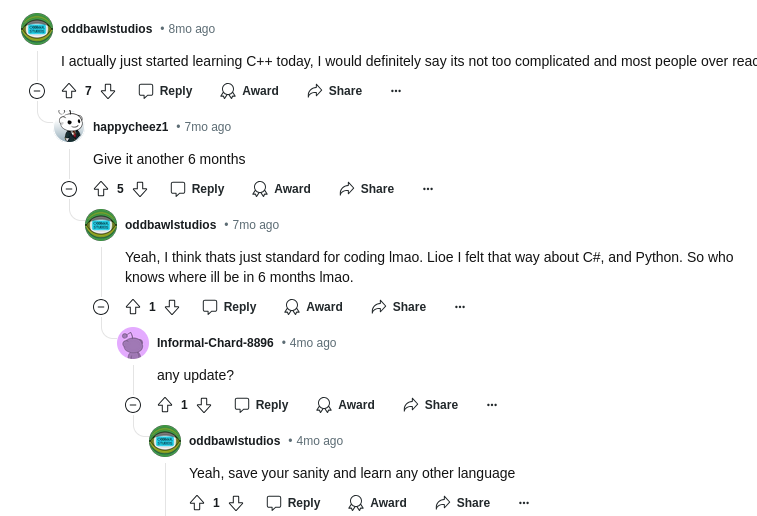
“Give it six months”
It only needed 3!
Particularly unexpected, because 3! = 6.
Disclaimer: I actually like C++ the language, I’m reasonably comfortable with it and enjoy it as an upgrade from C. I don’t use much OOP stuff as I’m writing a game using the flecs ECS. So things like abstract classes are mostly absent from my codebase.
What has been driving me up the wall the last month has been build systems and dependencies: don’t get me wrong; meson is great but the problem is not everyone uses meson. All I want to do is add some library built with cmake as a dependency without needing to rewrite the build system or install it on my OS. Apparently that is too much to ask!
I’m seriously considering dropping everything and jumping to Rust because of Cargo. Yes I’ve tried setting up conan but not having much fun since the recipes are all third party and out of date anyways
So things like abstract classes are mostly absent from my codebase.
I believe the consensus nowadays is that abstract classes should be avoided like the plague even in languages like Java and C#.
I have not heard this consensus. Definitely inheritance where the base class holds data or multiple inheritance, but I thought abstract was still ok. Why is it bad?
In 99% of the cases, inheritance can easily be replaced with composition and/or interfaces. Abstract classes tend to cause hard dependencies that are tough to work with.
I’m not sure why you would use abstract classes without data. Just use interfaces.
Say List is an interface.
You have implementations like ArrayList and LinkedList.
Many of those method implementations will differ. But some will be identical. The identical ones go in the abstract base class, so you can share method implementation inheritance without duplicating code.
That’s why.
If the lists have shared components then that can be solved with composition. It’s semantically the same as using abstract classes, but with the difference that this code dependency doesn’t need to be exposed to the outside. This makes the dependency more loosely coupled.
How do you implement an interface in C++ without an abstract class?
Rust’s cargo is great, I’d say it would be best to make the switch sooner rather than later once your code base is established. The build system and tooling alone is a great reason to switch
Reminds me of the joke about the guy falling from the top of the Empire State Building who, half way down, was heard saying: “Well, so far, so good”
Reminds me of the start of La Haine.
https://youtu.be/4rD05HsmtIU
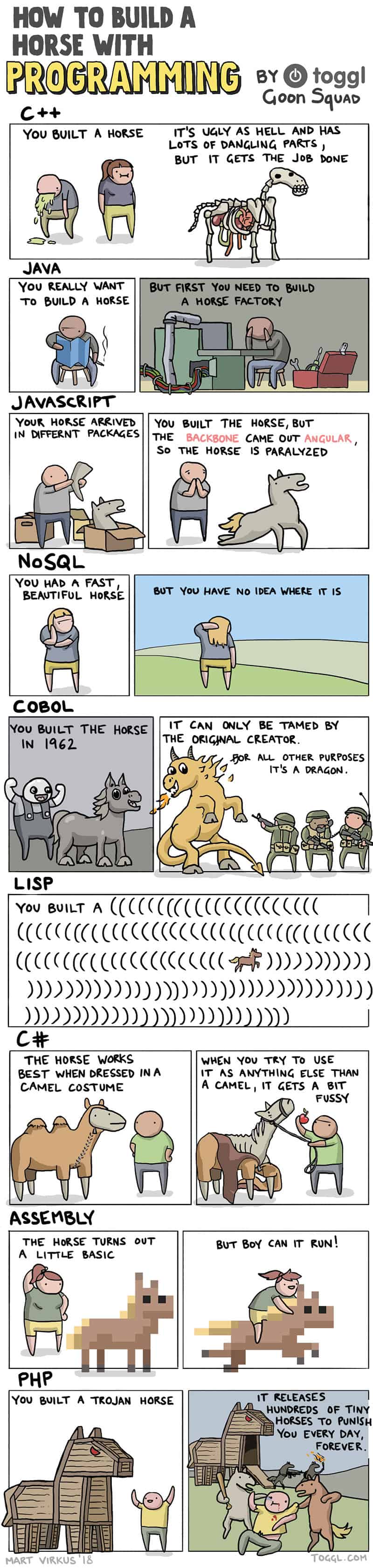
A friend of mine whose research group works on high throughout X-ray Crystallography had to learn C++ for his work, and he says that it was like “wrangling an unhappy horse”.
C is dangerous like your uncle who drinks and smokes. Y’wanna make a weedwhacker-powered skateboard? Bitchin’! Nail that fucker on there good, she’ll be right. Get a bunch of C folks together and they’ll avoid all the stupid easy ways to kill somebody, in service to building something properly dangerous. They’ll raise the stakes from “accident” to “disaster.” Whether or not it works, it’s gonna blow people away.
C++ is dangerous like a quiet librarian who knows exactly which forbidden tomes you’re looking for. He and his… associates… will gladly share all the dark magic you know how to ask about. They’ll assure you, oh no no no, the power cosmic would never turn someone inside-out, without sufficient warning. They don’t question why a loving god would allow the powers you crave. They will show you which runes to carve, and then, they will hand you the knife.
Instructions unclear, attempted to learn JS