• 0 Posts
  • 42 Comments
Joined 3 years ago
cake
Cake day: June 30th, 2023

help-circle


  • Not to mention that even if you personally managed to switch to something else, if you’re not doing some completely solo work, you will still receive files from others (or may be expected to send files to others) in Adobe format. So even if you wouldn’t be using it, you’d still have to pay for it to stay competitive. At which point you may as well use it because of what you said, that most of the alternatives are missing those expert features. So in professional setting, there’s unfortunately no escaping Adobe. Someone would have to come up with an alternative feature full package of apps covering all bases (because Adobe isn’t just Photoshop and not just graphic design but an entire interwoven ecosystem used in various related fields) and then work really, really hard to push the industry toward it. And it would still probably take a decade or two. So realistically, it would have to be or become some big corporation that would likely turn evil too as the time goes. Or some open source miracle like Blender that would have to attract enough big sponsors.

    Not defending Adobe, just saying how it is. I have enough grievances about their software (how they managed to fuck up something as simple as Acrobat is beyond me) but you just have to deal with it or look for a job in another field. (I’m lucky enough that Adobe is only secondary software for me but even then I still can’t escape it.)


  • I honestly don’t understand why anyone would refuse to switch from away Chrome. It’s not like the other browsers lack functionality or are slow. The only problem they might encounter is some rare incompatibility which is the result of Firefox (and its forks) small market share and web devs not caring enough.

    I’ve never used Chrome as my primary browser and I don’t think I missed anything. I started using Opera years before Chrome was even a thing (back when everyone was using IE) and then when the old Opera died, I didn’t think even for a second about switching to Chrome and went straight to Firefox. Which could at least be highly customized to bring some Opera exclusive features (eg. mouse gestures, tab grouping) back.


  • To be fair, let’s be glad that 80% of people don’t use an ad block. If it were the opposite and 80% did use ad block, web services would be much more aggressive in combating ad blockers and many more of them would end up pay-walled (although it seems we’re heading there anyway).

    On one hand, I feel kinda bad that my ad-free experience is only supported thanks to those who do undergo the torture of ads, on the other hand, the companies have only themselves to blame. If web ads were decent, only limited to sides and headers or even between paragraphs of web pages and didn’t cover the content you’re trying to view, didn’t try to trick you into thinking it’s part of the content, didn’t lead to malicious websites, didn’t autoplay videos with sound or didn’t put unskippable ads before and inside videos, I would have never felt the need to install an ad block.


  • The crazy part is that your brain is doing similar processing all the time too. Ever heard of the blindspot? Your brain has literally zero data there but uses “content-aware fill” to hide it from you. Or the fact, that your eyes are constantly scanning across objects and your brain is merging them into a panorama on the fly because only a small part of your field of vision has high enough fidelity. It will also create fake “frames” (look up stopped-clock illusion) for the time your eyes are moving where you should see a blur instead. There’s more stuff like this, a lot of it manifests itself in various optical illusions. So not even our own eyes capture the “truth”. And then of course the (in)accuracy of memory when trying to recall what we’ve seen, that’s an entirely different can of worms.


  • Dude, what the hell you’re onto?

    1280 x 800 is 16:10

    That’s exact.

    1280 x 720 is 16:9

    Also exact.

    1280 x 768 is also 16:10.

    In the link you provided, it literally says it’s 5:3. It even has its own line in the infographics. And while the article is titled “List of common resolutions”, it looks more like an exhaustive list of almost any resolution that has been ever used in any kind of consumer device. It’s definitely not limited just to standard computer monitors so that table isn’t really that relevant to the topic of the discussion.

    Also show me a monitor with the 1280 x 768 resolution that’s currently available on sale.

    You’re picking up some extremely rare cases to make an argument that your initial statement about “usually different aspect ratio” was correct but that’s not how it works. That’s just moving goalposts.


  • Nah there are more

    5:4, 8:5, 21:9, 64:27. And more

    I already mentioned 5:4 and 8:5 equals 16:10.
    21:9 and 64:27 are just ultrawide formats which I also mentioned and you can’t really mistake those for 16:9, can you? Same goes for 5:4 and 4:3 which are rather square-ish (4:3 was typical for old CRT monitors and TVs).

    And these aren’t exact. There’s fault tolerance, so to speak.

    I don’t think “fault tolerance” means what you think it means.

    You can have slightly different sizes rectangles between several different 16:9 monitors.

    Are you telling me that there are monitors that don’t have square pixels? Or that the number of (square) pixels doesn’t give an exact 16:9 ratio?

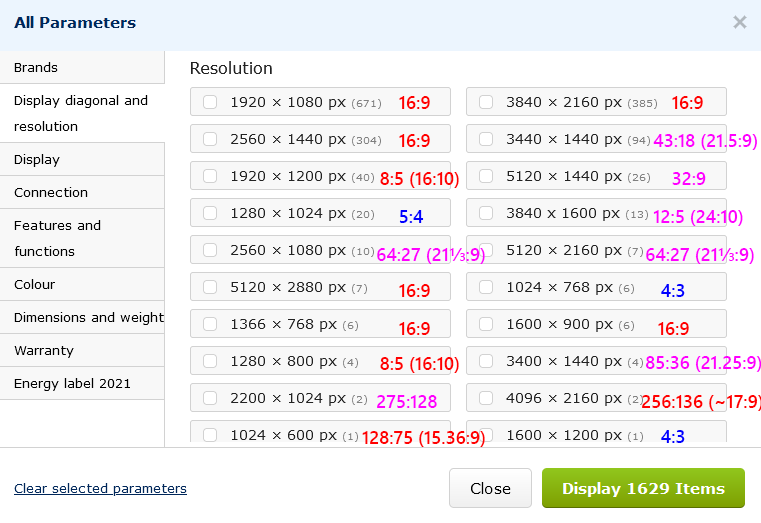
    Anyway, yes, there are more aspect ratios out there but the important thing is how common they are. I just looked at the biggest local e-shop and if I try to filter parameters by resolution, I get this:

    The number in the parenthesis next to the resolution is the number of products. (Note that this is only showing 1609 out of the total 1629 items - if I scroll down, there are 20 other options which all have 1 product each so I took the liberty to ignore those as those are ultra rare items (and some of them aren’t even regular monitors but just some specialized displays. Even here, for example the 2200×1024px is an e-ink touch screen)).

    I simplified each ratio to the simplest form, so those are exact ratios (but for some added a ratio with X:9 or X:10 in the denominator in parenthesis for easier comparison to those more standard formats). Turns out that 1379 out of 1609 monitors are exactly 16:9, so that’s 85.7%. The biggest variety are among the ultrawides which I colored in purple but again, those are pretty much unmistakable. Just like the 5:4 and 4:3 in blue.
    So realistically you have to watch out for the red ratios where 1379 out of 1426 are 16:9, that’s 96.7%.
    So I really wonder how you came to the conclusion that “monitors are usually a different aspect ratio to a TV”.
    Now of course one e-shop isn’t a completely representative sample but I hope we can agree that the numbers will be in the right ballpark. Feel free to make your own statistics from a different source.

    fault tolerance


  • monitors are usually a different aspect ratio to a TV

    What? Aren’t like 90% of monitors and 99% of TVs 16:9? There are a few monitors that are 16:10, some extremely rare 5:4 and 4:3 and then there are the ultrawide monitors which are obviously a different aspect ratio but saying that monitors are “usually” a different aspect ratio is factually incorrect. If you’re deciding between a 4K TV and 4K monitor, then there’s no danger of accidentally buying something of different format.